Saturday, March 19, 2011

Wrapup: Egypt's Constitutional Referendum

Today Egyptians voted ‘yes’ or ‘no’ on proposed amendments to the Egyptian constitution. It is the first vote held since the resignation of Egypt’s former president, Hosni Mubarak, in February, after nearly thirty years of rule.

The amendments were drafted by a committee appointed by Egypt’s ruling Supreme Council of the Armed Forces (SCAF) last month. Among other things, the amendments ease the requirements for presidential candidacy, require judicial supervision of elections, and require that Emergency Law be approved by the people if it is to be in effect longer than 6 months.

Polls opened at 8am across Egypt, and within hours turnout was unprecedented. By 9am, over 1,000 people were qued outside a polling station in Cairo’s Zamalek neighborhood, and there were similar scenes at many other polling stations. Some voters reported waiting in line for as long as five hours to cast their ballots.

One report said so many people had come to vote at the Faculty of Engineering polling station in Cairo that new ballot boxes had to be brought in because the first ones were filled. So many voters turned out in Upper Egypt that the Egyptian military flew more judges in to observe.

Despite the wait, millions of Egyptians were willing to stand in line for the chance to cast a ballot in what many feel will be the first vote where their ballot will actually be counted, and where the outcome is not a foregone conclusion. Egyptians young and old took pictures of their inked fingers to share with friends or post on their Facebook profiles.

While the vast majority of Egyptians were willing to wait in long lines to cast their ballots, Cairo’s governor, Abdel Azim Wazeer, was kicked out of a polling station by voters for not waiting his turn. In contrast, Twitter was buzzing this morning over Prime Minister Essam Sharaf’s refusal to cut in line. Instead, the Prime Minister waited in line with the people for his turn to cast his ballot.

As voting drew to a close, reports of irregularities and violations throughout the day continued to surface.

The most common irregularities in Cairo regarded the indelible ink and official stamps on ballots. Voters are required to dip their fingers in a bottle of ink which is supposed to stain their fingers for an extended period of time. It was particularly important today, as voters were allowed to vote with their national ID cards at the nearest polling station rather than with voting cards at a specific station.

While some Egyptians reported the ink was indeed permanent, others confirmed it washed off easily or wore off throughout the course of normal activity.

The second main complaint was that some ballots were missing the required official stamp, and voters worried those ballots would not be counted. However, a statement by the Supreme Judicial Committee in charge of supervising the referendum guaranteed the validity of the unstamped ballots so long as the signature of the supervising judge was present.

El-Sayyid el-Badawi, president of the liberal Al-Wafd Party, said the religious trends in Egypt abused the vote of the poor by telling them if they did not vote ‘yes,’ Article 2 of the Egyptian constitution will be canceled. Article 2 defines Egypt as an Islamic state and cites Islamic Sharia law as a source of legislation.

The Egyptian coalition for election supervision said the Muslim Brotherhood, generally considered Egypt’s largest and best organized opposition group, has used the slogan ‘Yes with Allah’ to convince its followers to vote yes.

In the city of Suez, mosques were used earlier in the day by Salafists to tell people they must vote ‘yes’ if they want to protect Sharia law. Also in Suez sources said there were many basic violations inside polling stations, including excessive presence of army personnel inside the polling stations and no curtains or voter privacy.

The campaigning has happened despite a statement from SCAF saying that any such campaigning was forbidden.

The Brotherhood is the only significant force outside the former ruling regime that called for a ‘yes’ vote in today’s referendum.

Despite its support of the amendments, however, the Brotherhood’s General Guide, Muhammad Badie, said the brotherhood will accept the outcome of the referendum whatever it is because it is the will of the Egyptian people and they are the real source of power.

Youm7 has learned that some polling stations have witnessed separate queues for Muslims and Christians, something not seen before in Egyptian polls. Separate queues - or even polling stations - for men and women are common.

According to reports, Human Rights lawyer Rajia Omran was arrested while monitoring polls in Bab el-Khalk after being asked to leave despite having a permit to monitor. Further details have not been made available.

Prominent Egyptian opposition figure and former head of the UN’s IAEA Mohamed ElBaradei was attacked by a mob throwing stones this afternoon as he went to vote in the Cairo neighborhood of Moqattam. According to reports, ElBaradei was met with chants of “we don’t want you” by people opposed to his presidential candidacy.

ElBaradei stated on his Twitter account that he went to vote with his family and was attacked by organized thugs who smashed his car with rocks. He said holding a referendum in the absence of law and order is an irresponsible act.

It is the first major report of violence from Cairo. There was also a report of a clash between two groups of voters in Daqahlia. The Egyptian Health Ministry said it has not received any reports of injuries related to today’s vote.

The lack of violence is significant: during November’s parliamentary elections, violence was widespread and three people died in Cairo alone.

Social media was once again an important tool for activists during today’s referendum. Egyptians discussed their experiences, shared which polling places were relatively empty and which had hours-long lines, and reported possible voting irregularities.

Despite the reports of violations, today’s vote saw far fewer irregularities and violations than are typical of Egyptian polls, in addition to seeing unprecedented voter turnout across Egypt. Many Egyptians are hopeful that the vote will be legitimate.

There were reports earlier in the day that polling stations would remain open past the originally scheduled closing time of 7pm due to high voter turnout, but it appears that polling stations were closed on time.

The past week saw intense debate over the amendments, but the vast majority of Egyptians will likely accept the results of the referendum, whatever they may be. Today, Egyptians had their first taste of democracy.

As one young Egyptian said on the social networking site Twitter, "Today Egyptians have demonstrated that they are ready for democracy, but the system is the one lagging far behind."

Friday, March 18, 2011

Full text of Egypt's constitutional amendments

The following is the full text in English of the proposed constitutional amendments which Egyptians will vote 'yes' or 'no' on in Saturday's referendum. Translation by the Egyptian governmentof the statement by the Supreme Council of the Armed Forces issued Saturday 26/2/2011:

Article 75: The elected president must be Egyptian and has Egyptian parents and enjoys civil and political rights. Any of his parents should not have obtained the nationality of any other country. He should not be married to a non-Egyptian and his age must not be less than 40 years.

Article 76: The president is elected through direct public secret ballot. The nomination for presidency must be supported by at least 30 elected members of the People's Assembly or Shura Council, or at least 30,000 eligible voters in at least 15 governorates so that the number of supporters in any of these governorates should not be less than one thousand.

In all cases, support should not be for more than one candidate.

Any political party whose members obtained at least one seat by voting in the People's Assembly or Shura Council can nominate one of its members for presidency.

A judicial commission, called the Presidential Elections Commission, is to supervise the presidential elections starting from the announcement of candidacy until the results of voting.

The committee is to be chaired by the head of the Supreme Constitutional Court and comprises the head of the Cairo Court of Appeal, the eldest Supreme Constitutional Court deputy, the eldest head of the Court of Cassation deputy and the eldest deputy of the State Council.

The commission's decisions are to be final and binding and non-liable to any appeals. They must not be halted or cancelled. The law is to define the other powers of the commission.

The Presidential Elections Commission is to form committees that supervise the balloting and counting as stated in Article No. 88.

The presidential elections organization bill is to be referred to the Supreme Constitutional Court to decide whether it complies with the Constitution.

The Supreme Constitutional Court is to announce its decision within 15 days of the date of reference. If the court decides that one or more articles are unconstitutional, its decision shall be binding. In all cases, the court's decision is to be binding. The decision is to be published in the official gazette three days after its issuance.

Article 77: It states that the presidential term is four years. The president can be only re-elected for one more term.

Article 88: The law specifies preconditions for eligible People's Assembly members and sets the rulings of elections and referendum.

Article 93: The Supreme Constitutional Court is in charge of deciding the validity of membership of the People's Assembly MPs.

Challenges are lodged with the court within a period that does not exceed 30 days since the announcement of election results. The court passes a ruling on the challenges within 90 days as of the time of receiving the challenges.

The membership of any MP is considered null as of the date of notifying the PA with the court ruling.

Article 139: The president of the republic must appoint, within 60 days at most since his assumption of power, one or more vice president and set his powers. If the need arises to relieve the VP from his post, he must appoint another.

Preconditions and accountability rules applicable to the president of the republic are the same for vice presidents.

Article 148: The president of the republic declares a state of emergency according to the law. The declaration must be referred to the People's Assembly within seven days since its announcement to issue a resolution on this score.

If the announcement was made while the parliament is in recess, it is required that the parliament convenes immediately to look into the announcement while observing the period mentioned in the previous article.

If the parliament is dissolved, the issue is referred to the new parliament at its first session. The issue must pass with the majority approval.

In all cases, the declaration of a state of emergency must not be for more than six months that must not be extended except after the approval of the people in a public referendum.

Article 179: Cancelled

Article 189 last para added:

The president of the republic has the powers, after the approval of the Cabinet, and also half of the People's Assembly and Shura Council have the powers to ask for issuing a new constitution. A Constituent Assembly of 100 members, to be mostly elected by the two houses of parliament at a joint meeting, undertakes outlining the new constitution at a period of time not more than six months since its formation. The blueprint is referred by the president of the republic within 15 days of its drawing to the people for referendum. The new constitution is applicable as of the date of approval by the people in the referendum.

Article 189 bis

Non-appointed members of the first People's Assembly and Shura Council convene to announce the results of the referendum on constitutional amendments for choosing the constituent assembly in charge of outlining the new constitution within six months of their election. This all comes in line with the last para of article 189.

Article 189 bis (I)

The first Shura Council exercises its powers after announcing the results of the referendum on constitutional amendments.

The president of the republic takes over, immediately after his election, completing the formation of the Council with appointing one third of its members. The appointment should be for completing the term of the Council according to the law.

Friday, March 11, 2011

Egyptian recounts being tortured by the army

23-year-old Rami Essam was tortured by the Egyptian army on March 9. The following is his testimony, originally posted on a Facebook note and later translated by Alive in Egypt. Rami is known for writing The Tahrir Song, which can be seen here.

My name is Rami Issam, 23 years old
I was in Tahrir Square with the rest of the protestors and demonstrators on Wednesday. March 9 At approximately 5 pm and a half we were surprised when the army along with a large group of armed civilians attacked the sit-in with bricks and stones. Alongside each other, they started breaking the tents, cutting the signs/banners, attacking all who are inside the circle with sticks and then started to arrest demonstrators. I was dragged by a group of soldiers beside the museum and was handed to Officers who then tied my hands and my feet.
They began to kick my body and face, and hit my back and feet with sticks, whips, pips, wires, and hoses.
Afterwards, they got an Electric detonator, the same kind that was used in the demonstrations and started electrifying different places in my body – with one device at first, then with more than one device at the same time. The military officers would leave me, throw stuff at my back, step on me, and throw shoes at my face. They cut my hair (It was long), and finally they put my face in the dirt and then filled my body with dust.

Rami recounts his testimony in the following video. Parts of the video are GRAPHIC, viewer discretion is advised.


Wednesday, March 9, 2011

Photo of the Week: Coptic boy at Cairo demonstration


A Coptic boy has an Egyptian flag, a cross, and a crescent painted on his face during a demonstration of Coptic Christians in Cairo on March 9, 2011.

Sunday, March 6, 2011

Egyptians uncover secret documents

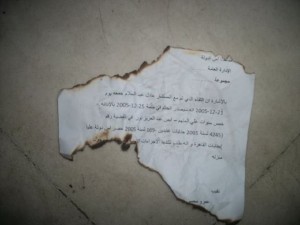
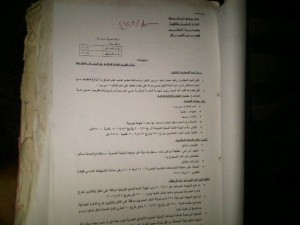
The following are images of documents uncovered on Saturday, March 5, 2011 when citizens stormed the Amn Dawla (State Security) headquarters in Cairo. The fall of Amn Dawla could prove to be more significant of impending change in Egypt than the fall of Hosni Mubarak.

This is only a small sample - there are thousands.

Document revealing the verdict of Ayman Nour's 2005 trial, four days before it was announced. By @kareem_elshaer.

Document revealing State Security plan to get rid of documents.
By @AEIMassry.

Citizens sort through documents inside Amn Dawla in Nasr City.
By @PakinamAmer.

Document from the 'Copts' file in Amn Dawla.
By @PakinamAmer.


Piles of documents being guarded by the military.
By @WaelAbbas.

Document revealing 29,000 tons of imported wheat were known to have radiation.
By @Crinckle0.

Thursday, March 3, 2011

Who, exactly, is currently running Egypt?

The Supreme Council of the Armed Forces was charged with the administration of Egypt when former president Hosni Mubarak stepped down on February 11, 2011. So for right now, they're the ones running the country. But who are they, exactly? This great chart, put together by The Arabist, explains:

To view the full-size image, go here: http://www.arabist.net/storage/uploads/SCAF.pdf

Sunday, February 27, 2011

Will Egyptians forgive the army's mistakes?


Egyptians love and respect their armed forces. Ever since the Egyptian army reclaimed the Sinai Peninsula from Israel in 1973, the army has been held in high regard by the people.
When military tanks rolled into Cairo on the evening of January 28, they were greeted with cheers, kisses, and flowers. On that Friday, they were received as saviors from the brutality of Egypt’s hated Central Security Forces, who for four days had attempted to put down the Egyptian uprising by using force against unarmed demonstrators. Finally, the army had arrived.
As demonstrations continued in Tahrir Square, tanks were covered with men, women, and children waving the Egyptian flag. Army personnel were greeted with smiles across the city, and they remained true to their word: they did not use violence against the demonstrators.
The Supreme Council of the Armed Forces was charged with the country’s administration on February 11, when Hosni Mubarak resigned from the presidency after thirty years in power. For the most part, Egypt’s people approved. There was some resignation, but the military is one of the few institutions most Egyptians trust.
Around the time of Mubarak’s resignation, there were whispers that the army was detaining people and holding them in the Egyptian Museum, located on the edge of Tahrir Square. The news stirred some talk, but it soon died down.
Over the past few days, however, the army’s relationship with the people has been tested. On Friday night, military police surrounded demonstrators outside the Egyptian parliament in downtown Cairo and instructed journalists to leave. In Tahrir Square, the army took down tents and chased demonstrators from the square with sticks and tasers.
Egyptians were outraged.
The incidents took place well after midnight, around 2am. “Why are they surrounding us, civilians, with weapons?!” asked Gigi Ibrahim, a young activist who has become a recognized and semi-permanent face in Tahrir Square. “The army is the same as the Central Security, just in different clothes,” wrote angry Egyptians on Twitter. Comparing the highly respected army to the hated and feared security forces shows how deeply shaken Egyptians were by the army’s actions.
It was a severe blow to their faith in the armed forces.
The next morning, cafes were buzzing with the news, as were social networking sites such as Facebook and Twitter. Some argued that the army was trying to enforce the curfew – which should run from midnight to 6am, and which demonstrators have mostly ignored – but had gone about doing so the wrong way. Some said the army was unused to dealing with civilians, others said its actions were inexcusable.
On Saturday night, dozens of groups of friends sat in plastic chairs drinking tea or Turkish coffee around small tables at El Boursa, a group of cafes in the financial district in downtown Cairo. Many were discussing the recently announced constitutional amendments, but the discussion inevitably turned to the incident with the army.
“What happened last night is very bad,” commented an elderly artist who had been an activist in his youth. Behind his glasses, his eyes were troubled.
Haitham, a young activist and member of the al-Ghad liberal party, was also concerned. “How could this happen?” he asked.
Many were worried about the incident, fearing it might be the beginning of a new policy of action by the military but hoping it wasn’t. As worrying as the events of Friday night were, many Egyptians wanted to believe the army’s actions were a mistake, and that the army was still on their side. On Saturday afternoon, the army released a statement on its Facebook page apologizing for the incident and saying some people were trying to undermine to goals of the revolution.
Some Egyptians were willing enough to accept the statement, but others remained wary.
The army must be extremely careful in both its actions and its image during this critical time in Egypt, because the people’s faith in the army is just as vital as sincerity on the part of the army if the transition to democracy is to be achieved. If the people’s trust in the army is severely shaken, their trust in the process facilitated by the army will be as well.
Already another video has begun circulating on Facebook and YouTube, showing a group of men detained by the army in Port Said. One man, blindfolded with his hands tied behind his back, is prodded by a soldier with a stick-like taser. Should similar evidence continue to surface, the Supreme Council of the Armed Forces is going to have a major problem on its hands.
Egyptians seem willing to forgive the army once, but they may not do so twice.
** This post was originally published as an op-ed in Bikya Masr

Friday, February 18, 2011

"I am Egyptian"


Piles of t-shirts spill out of suitcases on the ground. Young men with fistfuls of flags weave through the crowds, looking for buyers. Small groups gather to have the Egyptian flag painted on their cheeks free of charge. Young children are everywhere – in their mother’s arms, on their father’s shoulders, happily waving the Egyptian flag.

A week after the historic announcement that Hosni Mubarak was stepping down as president of Egypt, Egyptians are still celebrating.

Now, members of the military smile and pose for pictures where before they would sternly shake their heads. If families were common in Tahrir before Mubarak’s resignation, now they are everywhere. Even foreigners who have made Cairo their home have started to gather in Tahrir with their families and young children.

Increasingly the feeling in Tahrir Square is like that of a festival. Gone is the underlying tension, the worry that more government thugs will attack the peaceful atmosphere in Cairo’s Liberation Square.
On the other hand, some Egyptians stood in the square looking a bit bewildered. “We’re here… what do we do now?” one commented twenty-something girl to her friend.

Others have echoed the thought: Mubarak has left… why are they still gathering? Some come to honor the memories of the martyrs, whose pictures hang from various points along the square. Others come to visit with friends, for an afternoon out, or simply to bask in the strange freedom of gathering freely in public with thousands of others.

Egyptians are well aware that their struggle is not over. Much work remains to be done if Egypt is to become a democratic state. Even so, they seem intent on enjoying this first victory before moving on to the next battle.

Monday, February 14, 2011

Remembering the past as the future unfolds

For days I have sat here staring at a blank screen with no idea what to write. How do I express what I've seen in the past few weeks? How do I express how I feel, what I think? I have been remiss in uploading and publishing comments, news, anything.

Yesterday I stumbled upon Jehan Sadat's autobiography. Jehan was the wife of Anwar Sadat, the man who made peace with Israel and whose death left Hosni Mubarak in control of the country for the next thirty years. Somehow, the timing seems appropriate.

So far I've only read the first two chapters, where Jehan describes her husbands death, and then goes back to the beginning - growing up in Cairo. Some of the wonders she describes I've seen and wondered at myself: the oldest mosques, Coptic Cairo, Khan el-Khalili, the mix of modern and ancient, European and Egyptian.

Some of her memories are long gone, such as the Nile's annual flood, or watching the British move through the streets in their horse-drawn carriages.

But again, somehow the timing seems perfect. Now, as I prepare to go back to the beginning of what will be a new Egypt, I am remembering the sort of breathless awe with which I anticipated my first views of the city two and a half years ago. Part of me wishes I hadn't left in the middle of the Revolution, even though foreigners and journalists were being targeted. At the same time, I've always argued that one of the best parts about saying goodbye is that you get to say hello again. When I return to Cairo I will not only be saying hello again, to the city and to friends who have become like family, but I will be returning home to the beginnings of a new city.

Saturday, February 12, 2011

Egypt’s Revolution: A victory embodied by the Egyptian spirit

No one expected that peaceful protests and perseverance could topple the third-longest ruler in Egyptian history – but they did, and in less than three weeks.

What’s more, Egyptians won their victory as a people, not as a mass following a leader. Throughout history there have been various peaceful revolutions, but each had a figurehead: Nelson Mandela in South Africa, Gahndi in India, Martin Luther King in the Civil Rights movement in the United States. Each a worthy cause with a worthy leader.

Many images from the last nineteen days will be recorded in history: Egyptians chanting ‘peaceful, peaceful’ before being attacked by State Security; armored trucks turning water cannons on demonstrators as they prayed; Christian Egyptians surrounding their Muslim brothers, protecting them as they prayed; millions of people gathered in Tahrir – Liberation – Square.

These are the images of a people long known as friendly and hospitable, who have shown the world how deeply the Egyptian spirit runs.

In the early days of the revolution, for every young man who wanted to throw a stone at State Security forces there were five others to stop him. They would not instigate violence, but at a point demonstrators did retaliate: Police shot tear gas at demonstrators. The people kicked it away, threw it back, or tried to put it out. Police threw stones. Demonstrators threw them back. Police shot rubber bullets at demonstrators. Demonstrators set police vans on fire.

Even so, the overwhelming desire among the people was for everything to be peaceful. When State Security withdrew from Cairo on January 28, the people did not chase them out. On the contrary, I witnessed some demonstrators go to them and congratulate them, sharing the victory.

In less than three weeks Egyptians shattered the wall of fear which had kept them silent for decades. The wall had been cracked already, and the foundation was a bit unstable, but until January 25 that wall still stood. On the evening of January 25 I stood in Tahrir Square as tens of thousands of Egyptians gathered there for the first time, giddy with excitement.

I spoke with a lawyer who had helped found the human rights movement in Egypt in the 1970s, and had been part of the student demonstrations in 1973 and 1977. “I was here in Tahrir in 1977 and I was arrested for that demonstration,” he told me. “And now I am here again and I see all these young people, the age of my son and my daughters.” For him, as for many others, it was an emotional moment.

Destroying that ‘culture of fear,’ as I once heard it called, is one of the single most important victories of Egypt’s revolution. Whatever happens next, Egyptians now know that they can go to the streets and demand their rights.

So, what happens next? This is the question both Egyptians and the world have been asking for nineteen days. Hosni Mubarak, against all odds, is gone. What now?

Many have expressed the fear of a power vacuum. The military is in control, but that makes some uneasy. Others fear the Muslim Brotherhood will take over and impose some version of Islamic rule. Some of the fears are valid, some misplaced, but all seem to have overlooked the most important thing Egyptians have taught themselves and the world over the past nineteen days: Egyptians can take care of themselvevs.

Egyptians can take care of themselves. When the police pulled out of the city, Egyptians took it upon themselves to safeguard their homes and their history. They locked arms in front of the Egyptian Museum to protect it, and when thugs broke in from the roof the people quickly arrested them and turned them over to the army.

Within hours of the disappearance of security guards and traffic police, citizens organized road blocks, checkpoints, and neighborhood watch groups – and all without access to the internet or mobile phones.

Committees were organized to clean the streets and pick up garbage. People took it upon themselves to set up makeshift clinics in Tahrir Square and to bring food, water, and blankets to distribute to the people demonstrating there 24 hours a day.

Egypt did not fall into chaos, and did not fall for the rumors the government was trying to spread. In places where there was violence and looting, the people knew it was government-hired thugs and prisoners who mysteriously escaped from prisons who were causing trouble: it was not the people themselves.

The regime tried to force the people to choose between security and liberty and the people, in true Egyptian fashion, made their own option. They chose both. And it will not be quick or easy, but with more of the perseverance and compassion Egyptians have embodied in the last three weeks, they will keep both.