Video compilation of clips from Friday, January 28, 2011 in Cairo's Abdel Moneim Reyad Square, just steps from the now-iconic Tahrir Square.
Showing posts with label police. Show all posts
Showing posts with label police. Show all posts
Sunday, January 29, 2012
Egypt's Day of Rage as I saw it - Video
Video compilation of clips from Friday, January 28, 2011 in Cairo's Abdel Moneim Reyad Square, just steps from the now-iconic Tahrir Square.


Monday, January 23, 2012
Video: Egyptians take to the streets on Jan25
A brief look at January 25 through videos I captured, starting from Gameat al-Dowal Street in Mohandiseen into Tahrir Square.
Thursday, November 24, 2011
Mona Eltahawy speaks out about sexual assault by Egypt police
Mona Eltahawy speaks to CNN after being arrested, beaten, and sexually assaulted by Egyptian riot police.
She says, "I am one of many" who have faced such treatment and she wants the world to know the "brutality of the Egyptian police force." She says she finally refused to answer questions of the military investigations on the grounds that she is a civilian, and was released after about 12 hours in custody.
She says the Egyptian military apologized for the actions of the riot police and said they did not know why she was detained.
Mona was arrested sometime before 3:45am on Thursday, November 24, 2011 and released shortly after noon. For more on her ordeal, check her Twitter stream or these articles:
- Egyptian-American journalist arrested in Cairo
- Egyptian authorities release detained Egyptian-American journalist
She says, "I am one of many" who have faced such treatment and she wants the world to know the "brutality of the Egyptian police force." She says she finally refused to answer questions of the military investigations on the grounds that she is a civilian, and was released after about 12 hours in custody.
She says the Egyptian military apologized for the actions of the riot police and said they did not know why she was detained.
Mona was arrested sometime before 3:45am on Thursday, November 24, 2011 and released shortly after noon. For more on her ordeal, check her Twitter stream or these articles:
- Egyptian-American journalist arrested in Cairo
- Egyptian authorities release detained Egyptian-American journalist
Wednesday, November 23, 2011
Questions over type of gas used against Egypt demonstrators remain unanswered

Every Egyptian who was in the streets during Egypt’s January uprising, it seems, insists the gas used against demonstrators over the past five days is much stronger than what was used in January.
There are rumors that Egyptian Central Security Forces are not using CS gas, known as ‘tear gas’ and commonly used to disperse demonstrations, but the more debilitating CR gas. One difference in the substances is that while water dilutes CS gas, it exacerbates the effects of CR gas.
Some have claimed that there are nerve agents in the gases used against demonstrators in Mohamed Mahmoud Street, which connects Cairo’s iconic Tahrir Square to the Ministry of Interior in downtown Cairo.
Even Mohamed el-Baradei, a popular presidential hopeful and former director of the UN’s nuclear watchdog agency, has suggested that the gas used by riot police against demonstrators isn’t just tear gas.
“Tear gas with nerve agents and live ammunition are being used against civilians,” Baradei said on his official Twitter account on Tuesday. “A massacre is taking place.”
According to Ministry of Health figures, at least 35 people have been killed since clashes broke out between demonstrators and CSF on Saturday morning. Thousands have been injured.
Medics on the scene say the symptoms they have seen over the past five days are completely different from those they saw during demonstrations in January.
One medic told me today that the chest pain, convulsions and seizures caused by the gas during the past weel were not seen at all in January.
Many consider this proof that a different gas is being used.
However, there is another factor: the vast majority of the gas used in January was expired. Most canisters listed a manufacture date of 1999 with a five-year shelf life. The majority of the canisters seen over the past five days - either personally or in photos - were manufactured in August 2010 and consequently are not expired.
“It’s possible,” one medic told me when asked if the new symptoms could simply be from non-expired tear gas. “We won’t know until it’s tested in the lab.”
Two medics today told me that Human Rights Watch and other international NGOs have taken samples of the gases and canisters to determine what they are.
Many gas canisters are marked ‘RIOT CS SMOKE,’ but many more bear no markings whatsoever.
Another medic said samples analyzed in the pharmacy revealed minute traces of cyanide, an extremely deadly poison.
No other sources have confirmed or denied this, and me was not given access to the report.
The Egyptian Ministry of Health says it is also analyzing samples and will reveal the full results without holding anything back.
Some, however, are skeptical.
“We can’t trust what the Ministry of Health says,” one medic in Tahrir Square told me. “They won’t tell us the truth.”
The names of the medics who spoke to me have been withheld for their safety.
This post was initially published at Youm7 English Edition (offline since Jan 2012).
Monday, November 21, 2011

Video: Mohamed Mahmoud clashes
Short video of the first of now three days of clashes between Egyptian protesters and riot police on the streets of downtown Cairo.
Friday, July 1, 2011
Egypt policeman dances with sword during clashes
This video by independent Egyptian newspaper Al-Masry Al-Youm is one of the most disturbing things I've seen lately: as his colleagues throw stones at demonstrators in downtown Cairo on Wednesday morning, one soldier (likely a higher rank, as he isn't wearing a helmet or shield) dances around waving a machete and a long police baton.
Everyone around him completely ignores him:
Wednesday, February 2, 2011
Looking back: Abdelmonem Riad Square on January 28
This video was captured on Friday, January 28, 2011, Egypt's 'Day of Rage,' from Al-Jazeera's offices overlooking Abdelmonem Riad Square in Cairo, Egypt. In it can be seen the battle between police and demonstrators, including tear gas, stone throwing, and rubber bullets.
Looking back - Tahrir on February 1
Friends,
Internet service in Egypt has been cut almost entirely since midnight Thursday. The government undoubtedly cut service to disrupt coordination among would-be demonstrators in an effort to dissuade Egyptians from protesting.
The following is an article I wrote at midnight last night Cairo time, before Tahrir Square turned into the madness it is in now. Please, read and reflect on what the government is sanctioning here in Egypt.
Egypt Continues to Protest
Internet service in Egypt has been cut almost entirely since midnight Thursday. The government undoubtedly cut service to disrupt coordination among would-be demonstrators in an effort to dissuade Egyptians from protesting.
Two days earlier, on Tuesday, January 25, Egyptians went to the streets in numbers not seen since the 1970’s.
For human rights lawyer Amir Salem, the massive turnout of Egyptians demanding political change is something he never thought he would see. As a young man, Salem participated in the student demonstrations in Egypt in 1973 and 1977.
On the evening of January 25, Salem sat in Cairo’s Tahrir – Liberation – Square. “I was in prison for that demonstration in Tahrir Square” in 1977, he told me. “Now after thirty years I’m here watching the young people, and most of them are the age of my son and daughters. I am very, very happy.”
Wednesday saw a number of violent clashes between police and demonstrators across Egypt and a call for a major demonstration on Friday, January 28, nicknamed the 'Day of Rage.'
Activists frantically made phone calls late into Thursday night in anticipation of the government’s closure of mobile phone service, which indeed occurred around 9am on Friday morning.
“We arranged everything from yesterday because we knew what they would do,” prominent opposition figure George Ishak told me outside a café early on Friday morning. “We are now ready. The plan is ready.”
Some activists worried the lack of communications would stop Egyptians from going out on Friday.
It didn’t.
Egyptians braved tear gas, government thugs with sticks, water hoses, rubber bullets and buckshot-like live fire. In Abdelmonem Riad Square, behind the Egyptian Museum and steps from Tahrir, the afternoon saw a back-and-forth battle between demonstrators and police.
Police shot tear gas at demonstrators. The people kicked it away, threw it back, or tried to put it out. Police threw stones. Demonstrators threw them back. Police shot rubber bullets at demonstrators. Demonstrators set police vans on fire.
As dusk fell, demonstrators stopped retaliating. They lined up and began to pray, meters from where riot police with shields and guns stood in a ragged line. Shortly thereafter, a line of police trucks began moving out of the square and reports came that the army was moving in.
Watching from above, long-time opposition activist Gameela Ismail had tears in her eyes.
“I can’t believe what happened today,” said her teenage son, Shady. “The people beat the police. The police gave up.”
Student Sara Abed participated on Friday in Nasr City and then on the Qasr el-Nil bridge, which leads into Tahrir Square. “I think we made a clear statement to the government, although they are still denying it,” she told me in a café in Cairo's affluent Zamalek neighborhood on Saturday morning. “It’s our right to call for our demands. All the people will protest and they are willing to do it peacefully.”
“We’re not responsible for any damages,” she added. “It started by the government.”
Reports of looting and violence around Cairo had surfaced throughout the night. Downstairs in the café, the cashier was writing out orders and holding the cash in his hand because the cash box had been stolen during the night.
Egyptians have been extremely frustrated with the sporadic violent events. They stress that it is not the demonstrators or the Egyptian people who have been responsible for such acts, but government-hired thugs and plainclothes police officers attempting to convince the people to ask the police to return.
Al-Jazeera reported over the weekend that citizens had arrested a number of government thugs who had broken into the Egyptian Museum. The men, reportedly carrying secret security IDs, were then turned over to the army.
Abed reported seeing citizens standing arm in arm in front of the museum to prevent anyone from entering, something I also witnessed.
Since Friday, demonstrators have congregated in Tahrir Square under the watchful eye of the army. The army was greeted with relief by Egyptian citizens. While officially remaining politically neutral on the situation, the army has maintained the respect and appreciation of the people.
Around 5pm on Tuesday, February 1, two taxi cabs filled koshari, a typical Egyptian fast food dish, pulled up outside the military checkpoint leading into Tahrir Square. One of the cab drivers said the food had been paid for by the army and was to be distributed among the people.
Over a million Egyptians took to the streets across Egypt on Tuesday.
As night fell, Tahrir was still full of people. For the fourth night, people made fires, set up tents and other shelters, and settled in for the night. Groups continued to congregate. Posters with slogans in Arabic, English, and a dozen other languages remained scattered around the square.
Around 11pm, President Hosni Mubarak made a speech announcing he will not run for reelection this fall. As with other attempted concessions, such as dissolving the government and swearing in a Vice President, the statement was received with anger and disdain.
After eight days of protesting, Mubarak has made no indication of stepping down, which is foremost among the demands of the Egyptian people. The people are determined to continue their demonstrations until he does so.
Thursday, January 27, 2011
Egyptians hopeful for the future
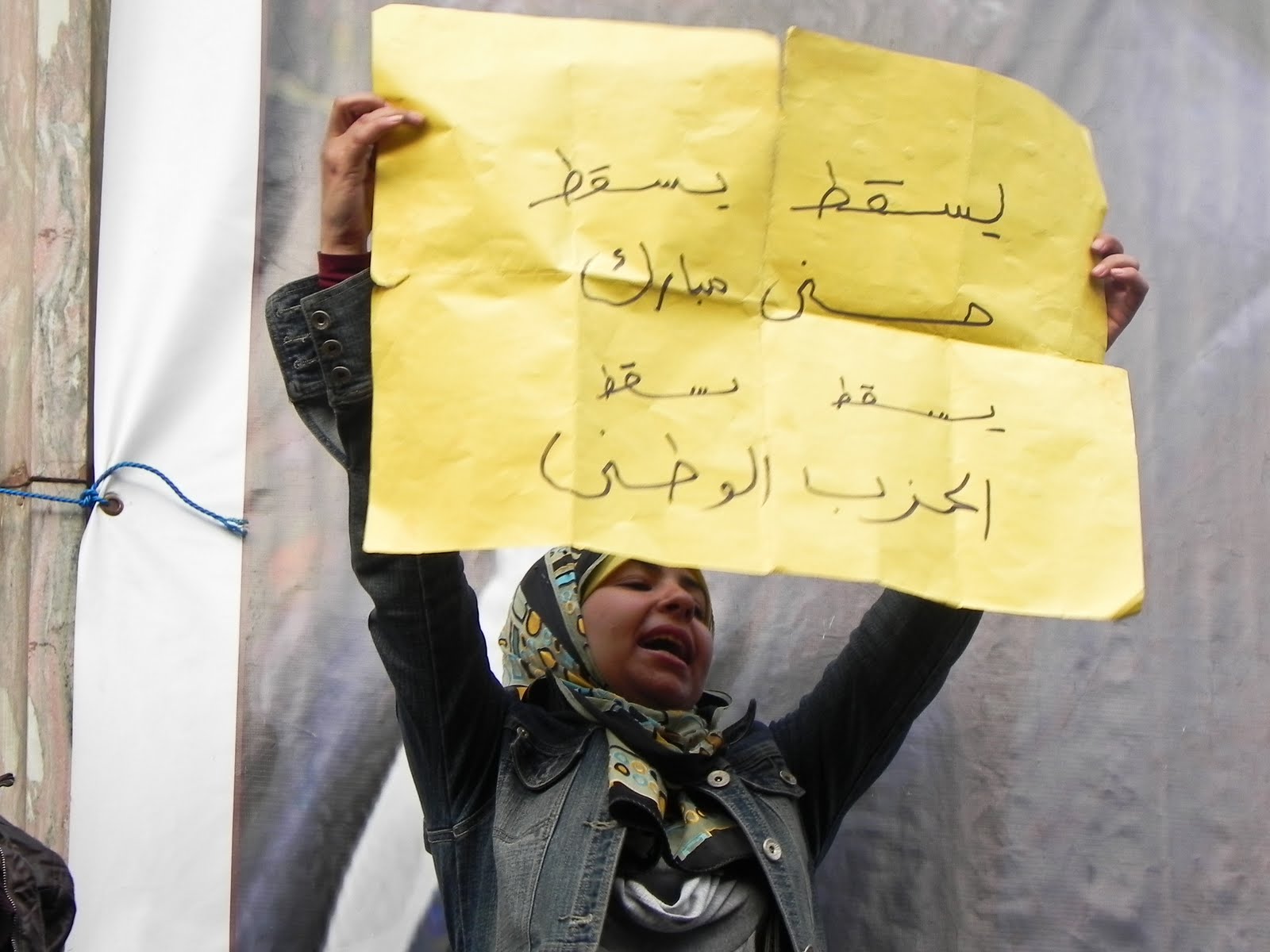 A sense of hope prevails in the streets of Cairo. Hope mixed with fear of how hard the government could crack down and uncertainty over what will happen next, but above all Egyptians have hope that maybe, just maybe, change is coming to Egypt.
For two days Egyptians have taken to the streets by the thousands, astounding both themselves and the world. Many thought the tens of thousands gathered in Tahrir Square on Tuesday night impossible in Egypt. Many thought Egyptians were too apathetic or too terrified of State Security.
On Tuesday, January 25, smaller gatherings converged on Tahrir Square through the afternoon and into the evening. Successive groups numbering from tens to thousands crossed the Qasr el-Nil brigde into one of Cairo’s most vital arteries. “Down, down with Hosni Mubarak!” they chanted.
They wore broad, sometimes giddy smiles.
Groups talked and laughed. Chants against a repressive regime sprouted again and again. Older men, some of whom participated in Egypt’s last great protests in 1977, discussed politics and smoked an endless chain of cigarettes.
Not all was peaceful: security forces hosed protesters with water and shot tear gas into the crowds. After midnight, Tahrir was ruthlessly cleared of any remnant of the day’s events.
Watching demonstrators press on through clouds of tear gas, watching families with young children brave the streets, hearing the raw emotion as Egyptians chant for freedom – one has the feeling of standing on the edge of something truly momentous.
But nothing is certain.
Wednesday, January 26 saw many small, disorganized demonstrations. The lack of communication meant no one knew where to go and most groups were quickly dispersed. It was also clear that no one expected the January 25 protests to be a success, because no one was ready for continued demonstrations on the 26th.
Even so, Egyptians have come to the streets in a way they have never done under Hosni Mubarak. The fear has been broken, and Egyptians are unlikely to give up and go home.
To quote one twenty-something Egyptian, “Tuesday was the happiest day of my life.”
Peaceful demonstrators attacked with tear gas, tasers
I caught this video last night outside Midan Talat Harb at around 9:30pm. Notice the lack of communication/coordination among the police: as two police try to talk down demonstrators, the first round of tear gas is fired from behind.
Wednesday, January 26, 2011

Saturday, May 15, 2010
Stolen passport nearly leads to deportation in Rome
On Wednesday, my good friend went to the police to report that his passport and permisso di soggiorno (permit to live in Italy) had been stolen. He's Sudanese, but carries a diplomatic passport and studies with me at the the American university here. He's lived in Rome for five years.
Once he finished filing the police report, the police told him, "Ok, so since you don't have any documents, we're going to arrest you now."
My friend was baffled. He was put into a police car and driven to an immigrant detention center outside of the city.
"Can I have my phone call now?" he asked.
"No."
He was placed in a holding cell and kept there for around five hours. After a while, he started talking to some of the other detainees, to pass the time. One of them is Ukrainian. "So, what are you in here for?" my friend asks.
"Oh, I raped a girl."
That ended the conversation.
My friend tried unsuccessfully to get the guards to let him out or at least give him a phone call. "I'm not a criminal!" he told them. "I've done nothing wrong!"
My friend tried unsuccessfully to get the guards to let him out or at least give him a phone call. "I'm not a criminal!" he told them. "I've done nothing wrong!"
They refused.
Finally, they told him he would be deported. He was told to leave the country within fifteen days and was forbidden to return to the European Union for five years and from setting foot on Italian soil for ten. They made him sign his deportation papers.
Then they let him go. But they don't tell him how to get home - they just let him out of the detention center somewhere outside the city at around 10pm.
The next morning he went to the Sudanese Embassy, which told him it could help but that this should be his last resort, and his university should deal with it. So he came back to the university and the guy in Student Life, God bless him, made one phone call and sorted the whole issue out. My friend was no longer required to leave the country, and what's more, he now had the right to sue the police.
I wish I could say this was a fluke case in Italy, but that wouldn't be true. In the northern part of the country, the Lega Nord runs (successfully, I might add) on a political platform which calls for kicking out all the immigrants. Some of its propaganda uses images of Native Americans and says the immigrants will soon force Italians onto reservations. Already, the Lega Nord has outlawed the opening of foreign food restaurants in areas where it has significant influence (the law is aimed mostly at kebab shops).
This is the reality of being a minority, particularly black and Arab, in Italy. Trying to work within the framework of the law to report stolen identity documents nearly results in one's deportation for failure to possess said documents. In reality, the relationship between the people and the state and the police is similarly dysfunctional across the Mediterranean. Take a look at what's happening now in Greece for another example: I've heard transcriptions of confrontations with police which are eerily similar to situations I've seen or heard about in Egypt.
Perhaps the advantage of being on this side of the Mediterranean, and attempting to be 'European,' is that my friend now has the right to sue the police, and can do so without fear of repercussion. He now has the law on his side.
Subscribe to:
Posts (Atom)