Showing posts with label state security. Show all posts

Sunday, March 6, 2011

Egyptians uncover secret documents

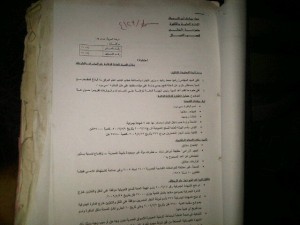
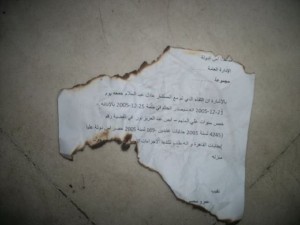
The following are images of documents uncovered on Saturday, March 5, 2011 when citizens stormed the Amn Dawla (State Security) headquarters in Cairo. The fall of Amn Dawla could prove to be more significant of impending change in Egypt than the fall of Hosni Mubarak.

This is only a small sample - there are thousands.

Document revealing the verdict of Ayman Nour's 2005 trial, four days before it was announced. By @kareem_elshaer.

Document revealing State Security plan to get rid of documents.
By @AEIMassry.

Citizens sort through documents inside Amn Dawla in Nasr City.
By @PakinamAmer.

Document from the 'Copts' file in Amn Dawla.
By @PakinamAmer.


Piles of documents being guarded by the military.
By @WaelAbbas.

Document revealing 29,000 tons of imported wheat were known to have radiation.
By @Crinckle0.

Saturday, February 12, 2011

Egypt’s Revolution: A victory embodied by the Egyptian spirit

No one expected that peaceful protests and perseverance could topple the third-longest ruler in Egyptian history – but they did, and in less than three weeks.

What’s more, Egyptians won their victory as a people, not as a mass following a leader. Throughout history there have been various peaceful revolutions, but each had a figurehead: Nelson Mandela in South Africa, Gahndi in India, Martin Luther King in the Civil Rights movement in the United States. Each a worthy cause with a worthy leader.

Many images from the last nineteen days will be recorded in history: Egyptians chanting ‘peaceful, peaceful’ before being attacked by State Security; armored trucks turning water cannons on demonstrators as they prayed; Christian Egyptians surrounding their Muslim brothers, protecting them as they prayed; millions of people gathered in Tahrir – Liberation – Square.

These are the images of a people long known as friendly and hospitable, who have shown the world how deeply the Egyptian spirit runs.

In the early days of the revolution, for every young man who wanted to throw a stone at State Security forces there were five others to stop him. They would not instigate violence, but at a point demonstrators did retaliate: Police shot tear gas at demonstrators. The people kicked it away, threw it back, or tried to put it out. Police threw stones. Demonstrators threw them back. Police shot rubber bullets at demonstrators. Demonstrators set police vans on fire.

Even so, the overwhelming desire among the people was for everything to be peaceful. When State Security withdrew from Cairo on January 28, the people did not chase them out. On the contrary, I witnessed some demonstrators go to them and congratulate them, sharing the victory.

In less than three weeks Egyptians shattered the wall of fear which had kept them silent for decades. The wall had been cracked already, and the foundation was a bit unstable, but until January 25 that wall still stood. On the evening of January 25 I stood in Tahrir Square as tens of thousands of Egyptians gathered there for the first time, giddy with excitement.

I spoke with a lawyer who had helped found the human rights movement in Egypt in the 1970s, and had been part of the student demonstrations in 1973 and 1977. “I was here in Tahrir in 1977 and I was arrested for that demonstration,” he told me. “And now I am here again and I see all these young people, the age of my son and my daughters.” For him, as for many others, it was an emotional moment.

Destroying that ‘culture of fear,’ as I once heard it called, is one of the single most important victories of Egypt’s revolution. Whatever happens next, Egyptians now know that they can go to the streets and demand their rights.

So, what happens next? This is the question both Egyptians and the world have been asking for nineteen days. Hosni Mubarak, against all odds, is gone. What now?

Many have expressed the fear of a power vacuum. The military is in control, but that makes some uneasy. Others fear the Muslim Brotherhood will take over and impose some version of Islamic rule. Some of the fears are valid, some misplaced, but all seem to have overlooked the most important thing Egyptians have taught themselves and the world over the past nineteen days: Egyptians can take care of themselvevs.

Egyptians can take care of themselves. When the police pulled out of the city, Egyptians took it upon themselves to safeguard their homes and their history. They locked arms in front of the Egyptian Museum to protect it, and when thugs broke in from the roof the people quickly arrested them and turned them over to the army.

Within hours of the disappearance of security guards and traffic police, citizens organized road blocks, checkpoints, and neighborhood watch groups – and all without access to the internet or mobile phones.

Committees were organized to clean the streets and pick up garbage. People took it upon themselves to set up makeshift clinics in Tahrir Square and to bring food, water, and blankets to distribute to the people demonstrating there 24 hours a day.

Egypt did not fall into chaos, and did not fall for the rumors the government was trying to spread. In places where there was violence and looting, the people knew it was government-hired thugs and prisoners who mysteriously escaped from prisons who were causing trouble: it was not the people themselves.

The regime tried to force the people to choose between security and liberty and the people, in true Egyptian fashion, made their own option. They chose both. And it will not be quick or easy, but with more of the perseverance and compassion Egyptians have embodied in the last three weeks, they will keep both.

Wednesday, February 2, 2011

Looking back: Abdelmonem Riad Square on January 28


This video was captured on Friday, January 28, 2011, Egypt's 'Day of Rage,' from Al-Jazeera's offices overlooking Abdelmonem Riad Square in Cairo, Egypt. In it can be seen the battle between police and demonstrators, including tear gas, stone throwing, and rubber bullets.

Looking back - Tahrir on February 1

Friends,
The following is an article I wrote at midnight last night Cairo time, before Tahrir Square turned into the madness it is in now. Please, read and reflect on what the government is sanctioning here in Egypt.

Egypt Continues to Protest

Internet service in Egypt has been cut almost entirely since midnight Thursday. The government undoubtedly cut service to disrupt coordination among would-be demonstrators in an effort to dissuade Egyptians from protesting.
Two days earlier, on Tuesday, January 25, Egyptians went to the streets in numbers not seen since the 1970’s.
For human rights lawyer Amir Salem, the massive turnout of Egyptians demanding political change is something he never thought he would see. As a young man, Salem participated in the student demonstrations in Egypt in 1973 and 1977.
On the evening of January 25, Salem sat in Cairo’s Tahrir – Liberation – Square. “I was in prison for that demonstration in Tahrir Square” in 1977, he told me. “Now after thirty years I’m here watching the young people, and most of them are the age of my son and daughters. I am very, very happy.”
Wednesday saw a number of violent clashes between police and demonstrators across Egypt and a call for a major demonstration on Friday, January 28, nicknamed the 'Day of Rage.'
Activists frantically made phone calls late into Thursday night in anticipation of the government’s closure of mobile phone service, which indeed occurred around 9am on Friday morning.
“We arranged everything from yesterday because we knew what they would do,” prominent opposition figure George Ishak told me outside a café early on Friday morning. “We are now ready. The plan is ready.”
Some activists worried the lack of communications would stop Egyptians from going out on Friday.
It didn’t.
Egyptians braved tear gas, government thugs with sticks, water hoses, rubber bullets and buckshot-like live fire. In Abdelmonem Riad Square, behind the Egyptian Museum and steps from Tahrir, the afternoon saw a back-and-forth battle between demonstrators and police.
Police shot tear gas at demonstrators. The people kicked it away, threw it back, or tried to put it out. Police threw stones. Demonstrators threw them back. Police shot rubber bullets at demonstrators. Demonstrators set police vans on fire.
As dusk fell, demonstrators stopped retaliating. They lined up and began to pray, meters from where riot police with shields and guns stood in a ragged line. Shortly thereafter, a line of police trucks began moving out of the square and reports came that the army was moving in.
Watching from above, long-time opposition activist Gameela Ismail had tears in her eyes.
“I can’t believe what happened today,” said her teenage son, Shady. “The people beat the police. The police gave up.”
Student Sara Abed participated on Friday in Nasr City and then on the Qasr el-Nil bridge, which leads into Tahrir Square. “I think we made a clear statement to the government, although they are still denying it,” she told me in a café in Cairo's affluent Zamalek neighborhood on Saturday morning. “It’s our right to call for our demands. All the people will protest and they are willing to do it peacefully.”
“We’re not responsible for any damages,” she added. “It started by the government.”
Reports of looting and violence around Cairo had surfaced throughout the night. Downstairs in the café, the cashier was writing out orders and holding the cash in his hand because the cash box had been stolen during the night.
Egyptians have been extremely frustrated with the sporadic violent events. They stress that it is not the demonstrators or the Egyptian people who have been responsible for such acts, but government-hired thugs and plainclothes police officers attempting to convince the people to ask the police to return.
Al-Jazeera reported over the weekend that citizens had arrested a number of government thugs who had broken into the Egyptian Museum. The men, reportedly carrying secret security IDs, were then turned over to the army.
Abed reported seeing citizens standing arm in arm in front of the museum to prevent anyone from entering, something I also witnessed.
Since Friday, demonstrators have congregated in Tahrir Square under the watchful eye of the army. The army was greeted with relief by Egyptian citizens. While officially remaining politically neutral on the situation, the army has maintained the respect and appreciation of the people.
Around 5pm on Tuesday, February 1, two taxi cabs filled koshari, a typical Egyptian fast food dish, pulled up outside the military checkpoint leading into Tahrir Square. One of the cab drivers said the food had been paid for by the army and was to be distributed among the people.
Over a million Egyptians took to the streets across Egypt on Tuesday.
As night fell, Tahrir was still full of people. For the fourth night, people made fires, set up tents and other shelters, and settled in for the night. Groups continued to congregate. Posters with slogans in Arabic, English, and a dozen other languages remained scattered around the square.
Around 11pm, President Hosni Mubarak made a speech announcing he will not run for reelection this fall. As with other attempted concessions, such as dissolving the government and swearing in a Vice President, the statement was received with anger and disdain.
After eight days of protesting, Mubarak has made no indication of stepping down, which is foremost among the demands of the Egyptian people. The people are determined to continue their demonstrations until he does so.

Thursday, January 27, 2011

Peaceful demonstrators attacked with tear gas, tasers


I caught this video last night outside Midan Talat Harb at around 9:30pm. Notice the lack of communication/coordination among the police: as two police try to talk down demonstrators, the first round of tear gas is fired from behind.

Tuesday, January 25, 2011

Is it a revolution?

At 8:30pm, thousands are gathered in Tahrir Square in downtown cairo. The exits are secured by volunteers, but people are allowed to exit and re-enter at multiple points. It has been a long day, and it is far from over.

A veiled girl wanders through the crowd collecting money in a helmet to bring food for everyone gathered. Every so often cheers erupt, but things are calm.

A few hours earlier, that wasn't the case. At around 3.30pm, I was with a group of roughly 2,000 Egyptians - young men and women, parents with their children, and elderly people - who made their way from Gameat al-Dowal street through Mohandiseen, across Zamalek, and into Tahrir Square. It wasn't long before State Security drove a truck through the crowd and blasted demonstrators with water. Within moments, however, a brave young man managed to climb on top of the truck and turn the water away. He was removed by plain-clothes security, but he succeeded in turning off the water.

Later, volleys of tear gas were fired into the crowd. They sent streams of white smoke through the air and billowed where they fell. Demonstrators ran from the attack - but they never went far. Despite the tear gas, the water, and falling darkness, Egyptians remained where they stood.

Throughout the march to Tahrir, demonstrators called to citizens watching from balconies: "Come, join us! Come out! Where are Egypt's people?"

Prominent opposition figure Gameela Ismail pleaded with bystanders through the entire march to join. One young woman hid behind a friend, another on a balcony smiled nervously and looked away, but an older veiled woman shrugged and stepped off the sidewalk and into the street.

A man wearing an Egyptian flag tied around his shoulders walked hand in hand with two young sons, with his wife and daughter before him.

While security has used tactics such as tear gas and hoses and many have gathered with sticks, the violence is not as bad as expected, and far from what it could be.

Rumors circulate the crowd in Tahrir that demonstrators in Alexandria and Mahalla have taken over the offices of the ruling National Democratic Party there. It is an extremely symbolic move - and the night is far from over.

Saturday, November 27, 2010

Egypt: On the Eve of Elections

Gameela Ismail campaigning before elections
Tomorrow Egypt will hold parliamentary elections. The world is watching and the government is ready. Reports of irregularities are already making local and international news. Everyone wonders what will happen - will the opposition win any seats? What about the Muslim Brotherhood? Perhaps most importantly: will the vote be fair?

It's important for observers to realize what appears on Egypt's surface and what happens under it are two entirely different things.

One of the best pieces of advice I received back when I was doing research for a capstone thesis on current Egyptian politics was to try to be as Egyptian as possible when looking at what was happening around me. It sounds simple, but it is both difficult and vitally important. It's like looking at an orange and breaking it open to find an onion.

Here are a few quick facts about Egyptian politics:
  1. Egypt is a dictatorship. Egypt's 82-year-old president, Hosni Mubarak, has held the position for thirty years.  This makes him Egypt's third-longest ruler ever, including the pharaohs of old. One way Mubarak holds onto his power is through the army. Egypt has lived under Emergency Law - essentially military rule - since Anwar Sadat was assassinated thirty years ago.
  2. Egypt does not have a pluralistic political system. Many outsiders look at Egyptians politics, see the names of many political parties, and come to the conclusion that there is a vibrant, pluralistic political life. In reality, nearly all of Egypt's "opposition" parties have deals with the government whereby they act like opposition for the media in return for certain political or other benefits.
  3. Egyptian elections are neither free nor fair. Egyptians know this. It contributes to the extreme apathy most Egyptians feel. Additionally, Egyptian politicians buy votes. Outright. Egyptians know this as well, and some even call candidates to find out who will pay the most for their vote.
  4. Egyptians are terrified of their government. There are exceptions of course, but many Egyptians would literally start shaking in their boots if someone confronted them with criticism of the government. They whisper that there is always someone listening - and usually, they're right.
Gearing up for tomorrow's elections, the regime has already made it difficult for candidates or observers to expect a fair race. In 2005, the elections were spread out over a period of time to ensure each polling station would be overseen by a judge. This year, all the elections will take place in one day - meaning there is no possible way for judicial oversight.

Secondly, the government waited until a month before the election to announce its official date. It also stipulated that campaigning would only be permitted starting fourteen days before the election. The campaign period was strategically scheduled during a major, week-long Islamic holiday.

More recently, the government has stated that journalists will need special passes to report on the elections and that Egyptian civil society has the right to observe the elections, but not the right to monitor them.

Getting around the restrictions
There is always an exception to the rule. In the case of this year's parliamentary elections, that exception may well be independent candidate Gameela Ismail (for more about Gameela, check out my earlier post about campaigning with her).

"I am outside the regime's calculations," Gameela told me a few weeks ago, just after she had submitted her papers to run for parliament in Qasr el-Nil, a strategic district in downtown Cairo. To outsiders, it may seem impossible an impossible battle.

Yet Gameela may have exactly what it takes to get around the regime's restrictions. Gameela has battled Egyptian State Security for years and knows exactly what it is capable of.

The combination of Gameela's knowledge of State Security's tricks and their strong desire to keep her at arm's length could serve her well in Sunday's polls. Gameela knows how to deal with State Security and State Security knows better than to make her mad. She'll sit in their offices or keep them standing in the street until she gets what she wants - I've witnessed both tactics.

Over the past few days, many independent and opposition candidates have found their petitions to have representatives in the polling stations on Election Day denied outright. Gameela had a day-long verbal battle with State Security in Qasr el-Nil, but at the end of the day she got what she wanted: permission for her representatives to be in the polling stations.

(Representatives are allowed to remain inside the polling stations to keep an eye on the ballot boxes and watch for irregularities.)

Will it be enough to win her the election? Maybe not, but she has a fighting chance.

Tuesday, September 21, 2010

Egyptian State Security intimidated by two women

Our female 'babysitter'
Today was somewhat fascinating from an objective perspective, if intensely boring for those actually involved.

I spent three and a half hours standing in the street with prominent public figure and activist Gameela Ismail this afternoon, after we were prevented from reaching our intended destination by Egyptian State Security. While droves of young football fans were rioting in Zamalek and over 1,000 demonstrators (according to the accounts of others) were gathered near Abdeen Palace, Gameela and I were apparently important enough to have the attention of more than a dozen high-level security officers and the divided attention of around 80 uniformed and plain-clothes police. Who knew two women needed so many babysitters!

Gameela and I reached a side street leading to Abdeen Square - where the President lives, in Abdeen Palace - around 4:15pm. We were stopped just steps from the square itself by a handful of plainclothes officers. They instantly recognized Gameela, who is something of an icon to Egyptians (wife of former Presidential candidate Ayman Nour, Gameela has become an advocate for women's, human, and civil rights, and is extremely active in fighting the regime). Within moments, the number of officers around us multiplied and we were also joined by three women, one in uniform.

Over the next three and a half hours, our babysitters consistantly refused to let us enter Abdeen Square. They tried to get us to go around by means of a narrow alleyway, but Gameela and I were smart enough not to fall for that. Uniformed and plainclothes police diverted pedestrians, and one high-ranking plainclothes officer even told passerby not to look at us.

While being kept from the demonstration - which we could neither see nor hear - was frustrating, I did find it telling that State Security found it necessary to spend so many resources on two women, especially after it became clear that other demonstrators were not coming to our location. Yet our security remained tight, particularly after Gameela managed to move about 5 meters closer to the square when our babysitters were distracted. We were closely surrounded by a group of fifteen uniformed and plainclothes police, and the uniformed female officer and another plainclothes office joined us in our little circle. At least 30 other State Security members watched us from within 30 meters, with others spread beyond that.

Around 7:30pm we learned, via phone and Twitter, that the day's protest was winding down. A few minutes later Gameela told the lead babysitter 'salam w'alaikom' and we walked past our guards away from the square, back towards the car, and left.

What I have to wonder is why we were so interesting. Even if the large numbers of state security were mere coincidence, why was it necessary to keep us so surrounded, particularly when we were still clearly in the eye of passerby? Why was state security so intent to keep Gameela from joining the protest, when other figures such as Ayman Nour and Hamdeen Sabbahi were already there? Is Egypt's State Security really that scared of Gameela Ismail?

Thursday, April 8, 2010

April 6, 2010: Ayman Nour's Commentary and Call for Solidarity

Ayman Nour recounts the events at al-Ghad headquarters on April 6, 2010 and calls for solidarity from the international community:


Tuesday, April 6, 2010

My run-in with Egyptian state security

Today I witnessed a fraction of what Egyptian activists face.

Today is the second anniversary of the April 6, 2008 protests, which were the first simultaneous nation-wide protests in Egypt. The 6 April Youth, who became known after the protests, planned another strike for today. It was supposed to be a peaceful protest march from Tahrir Square to the Egyptian Parliament a few blocks away.

The Government was ready and in no mood to deal with protesters.

Another American journalist and I met at Ayman Nour's apartment in Zamalek at 10am. As we prepared to head downtown, one of Nour's people gave us a few suggestions: don't wear gold jewelry, and memorize someone's number in case you are arrested and they confiscate your phone. I rolled up my sleeve and wrote a few numbers - without names - on my arm. My friend did the same. My roommate and her roommate - non-political friends - and my editor.

Police standing outside the Journalists Syndicate in downtown Cairo
As our taxi neared Talat Harb street, the government's preparations were obvious. Uniformed police lined the streets. Large green military trucks were parked end to end on side streets, as many as eight in one place, each full of soldiers. The atmosphere was already tense.

Our initial destination point was the al-Ghad party headquarters on Talat Harb street. Before going to the headquarters, however, my companions and I decided to take a look at what was happening in Tahrir.

At around 11am we were walking from Talat Harb through Tahrir Square in downtown Cairo (where the Egyptian Museum and the American University are located). My friend and I stayed a dozen meters in front of our al-Ghad friends, figuring we would have more freedom to snap pictures as 'tourists' if we weren't associated with them.

As it turns out, that wasn't really the case.

I snapped a few pictures of the police lining Tahrir as we entered the square and then turned my camera off. My friend panned her camera around the square and toward the police. Suddenly, three angry men were coming straight toward us. It was immediately clear that these were plain-clothes security, and they were not happy.

Riot police in Tahrir Square
"Give me your camera," said the man in charge. "Give it to me. Let me see." He roughly grabbed my friend's camera, trying to pull it away from her.

"You can't do that!" She said, pulling away from him.

In the few seconds the exchange took, we were surrounded by plain-clothes security. One grabbed my arm, attempting to pull me away from my friend, while the first attempted to pull her camera away again. She held onto her camera and I held on to her, and we tried to walk away. Security blocked our path. "I'm an American citizen! You can't do this to me!" my friend shouted. The security pressed in closer. "Somebody help me! I'm an American citizen!" We were drawing looks from passerby. One of the security men waved his arm and we were completely encircled.

After a few intense minutes of arguing, we were ushered against the wall of the building behind us (Hardees). We were less conspicuous there, but we were still making a scene and the police were not pleased.

They also didn't believe a word that came out of my friend's mouth. They weren't terribly interested in me, possibly because they hadn't seen me taking pictures, but they interrogated my friend endlessly. Where are you from? What is your job? Why are you here? They didn't believe her story - that she was a student and happened to be in the wrong place at the wrong time (later, when we saw the same security men in a coffee shop around the corner, the head man said flatly to my friend: "You are a liar").

Finally a female security officer in uniform came over (this is the first time female officers have been deployed during a protest, and later in the day they proved just as brutal as the men). She went through our bags piece by piece. The first man had already taken a copy of my friend's passport (which we never saw again), but I had no identification on me. Looking back, I'm glad - they don't know who I am.

The whole time, my friend had been on the phone with our al-Ghad friends and others, letting them know that while we were being detained, we would be okay. Whatever happened, we did not want our al-Ghad friends to show up: if they did, our story about being in the wrong place at the wrong time would be shot. As it was, the officers were demanding to know who we were on the phone with. "Who is Badawy?" they demanded.

After another ten minutes or so, another plain-clothes officer arrived. He was better dressed and clearly had more authority than the officers who had been dealing with us so far. He was smiling as he ambled over.

"What is the problem?" he asked.

"I've been all over the world, and I've never had problems with the police!" fumed my friend.

"You still don't have trouble with the police," said the man, still smiling amiably. At this point I was shaking, half from nerves and half on purpose. He looked directly at me. "Why are you frightened?" he asked.

Eventually he 'explained' to us that there were demonstrations, and it was a security matter that we weren't allowed to take pictures. After a few more minutes of this back-and-forth, someone said, "okay okay, come this way." We were ushered around the corner onto another street, and when we looked behind us we realized we were no longer being accompanied by security. We were free to go, it seemed.

Needless to say, my friend and I were a bit shaken up. Our encounter with the police had been pretty intense.

What we faced was only a small taste of what Egyptian activists face: as Americans, the regime is less likely to physically harass us.

Even so, we knew going back to the protest was going to be a bad idea. We finally made the decision not to go back into Tahrir. We considered moving to the al-Ghad headquarters, but my friend had a bad feeling about it, and luckily we went with her gut: around the time we would have arrived, there was a confrontation with state security outside the headquarters when Ayman Nour and his supporters attempted to leave the building. They were eventually forced back inside and the door was barricaded for over three hours, with no one allowed out. Ayman Nour's eldest son was briefly detained by security, and the scratches and bruises on his neck are a testament to the way he was manhandled by the plain-clothes officers.

Noor Ayman Nour, eldest son of Ayman Nour, arrested near Talat Harb.
Photo by Al-Jazeera.
It's too soon to really say if the day was successful or not, but... here are some thoughts and facts:
  • Over 80 persons were arrested and moved to the police station in Nasr City.
  • There were violent confrontations between police and protesters in Tahrir and also outside the parliament; there were even female police beating female protesters, and two women sustained broken arms.
  • More than 70 people were locked inside al-Ghad headquarters;
  • Violent clashes occurred in Alexandria;
  • Mobile phones and gold jewelry were confiscated by security around the parliament;
  • ElBaradei was completely absent from the scene, and there is a possibility that this will hurt his reputation here. Already there has been much criticism on both Facebook and Twitter.
I'll get back to you on some of this soon... there's so much I want to say, I don't really know where to begin.
Breaking news: April 6 events

Will write more later, but for now, here's what's going on:
  • more than 70 people arrested in Tahrir Square and in front of the Parliament
  • more than 70 people locked inside al-Ghad headquarters on Talat Harb Square, including party leader Ayman Nour
  • two al-Ghad members briefly detained, released, including the son of Ayman Nour
  • Amnesty International member arrested
  • people being beaten in Tahrir Square
  • reports of sexual harassment and confiscation of mobile phones
State security is everywhere.