Video compilation of clips from Friday, January 28, 2011 in Cairo's Abdel Moneim Reyad Square, just steps from the now-iconic Tahrir Square.
Showing posts with label police brutality. Show all posts
Showing posts with label police brutality. Show all posts
Sunday, January 29, 2012
Egypt's Day of Rage as I saw it - Video
Video compilation of clips from Friday, January 28, 2011 in Cairo's Abdel Moneim Reyad Square, just steps from the now-iconic Tahrir Square.


Thursday, November 24, 2011
Mona Eltahawy speaks out about sexual assault by Egypt police
Mona Eltahawy speaks to CNN after being arrested, beaten, and sexually assaulted by Egyptian riot police.
She says, "I am one of many" who have faced such treatment and she wants the world to know the "brutality of the Egyptian police force." She says she finally refused to answer questions of the military investigations on the grounds that she is a civilian, and was released after about 12 hours in custody.
She says the Egyptian military apologized for the actions of the riot police and said they did not know why she was detained.
Mona was arrested sometime before 3:45am on Thursday, November 24, 2011 and released shortly after noon. For more on her ordeal, check her Twitter stream or these articles:
- Egyptian-American journalist arrested in Cairo
- Egyptian authorities release detained Egyptian-American journalist
She says, "I am one of many" who have faced such treatment and she wants the world to know the "brutality of the Egyptian police force." She says she finally refused to answer questions of the military investigations on the grounds that she is a civilian, and was released after about 12 hours in custody.
She says the Egyptian military apologized for the actions of the riot police and said they did not know why she was detained.
Mona was arrested sometime before 3:45am on Thursday, November 24, 2011 and released shortly after noon. For more on her ordeal, check her Twitter stream or these articles:
- Egyptian-American journalist arrested in Cairo
- Egyptian authorities release detained Egyptian-American journalist
Friday, July 1, 2011
Egypt policeman dances with sword during clashes
This video by independent Egyptian newspaper Al-Masry Al-Youm is one of the most disturbing things I've seen lately: as his colleagues throw stones at demonstrators in downtown Cairo on Wednesday morning, one soldier (likely a higher rank, as he isn't wearing a helmet or shield) dances around waving a machete and a long police baton.
Everyone around him completely ignores him:
Tuesday, June 7, 2011
Remembering Khaled Said
 Some would argue his death started a revolution – or at the very least was one of its major catalysts. Khaled Said is still burned into Egypt's memory a year after his brutal death.
Today Egyptians gathered in Cairo, Alexandria and Fayoum to remember Khaled.
While the exact details continue to be disputed, Khaled was killed at the hands of Egyptian police in Alexandria on June 6, 2010. He was beaten to death and his body was dumped his home. Four days later his story spread rapidly across the internet after prominent opposition politician Ayman Nour publicized Khaled’s death and pictures of his mangled face.
Egyptians were outraged. Protests were organized. In Khaled’s home city of Alexandria, men and women stood along the corniche, the road separating the city from the Mediterranean Sea, every Friday afternoon. They dressed in black. They carried the Bible or the Quran, and they prayed silently for Khaled’s soul.
Stark images of educated, upper-middle-class youth stretching down the corniche drew more attention. These were not the small, violent demonstrations Egyptians were accustomed to. Those attending actually had something to lose.
Yet Khaled was not the first to die at the hands of Egyptian police. There were many before him. So why did Khaled Said, a 28-year-old businessman, draw millions of supporters to a Facebook page within days? Why were weekly demonstrations organized in Alexandria and Egypt’s capital, Cairo, for months after his death?
Ultimately, the answer is simple: Egypt’s politically inactive middle class considered him one of their own.
Shortly after news of Khaled’s murder was made public, an Egyptian friend told me why he – an upperclass Egyptian who wasn’t involved in politics and had the money for a good education – was so affected by Khaled’s death: “He didn't look for trouble, yet corruption killed him anyway. Maybe they've done worse things before, but this directly threatens me: this is a young guy who comes from almost the same background as me and most of my friends. He does the same things that I do. He stays out of trouble. And yet, this.”
My friend, like many other Egyptians, believed he could be next.
While some of those who publicized Khaled’s case were seasoned activists, many more were not. For the first time, portions of Egypt’s middle class went to the streets in public demonstrations – perhaps the most politically repercussive aspect of Khaled’s death.
In the earliest days of Egypt’s January 25 Revolution, the people taking to the streets were not underpaid laborers or career activists. They were Egypt’s educated middle class, and the first time they had gone to the streets was after Khaled’s death. There were chants for better wages and economic issues, but the calls for democracy, freedom, and human rights were louder. It was, in the beginning, not a bread uprising but a call for what many have termed the “Western” ideals of personal freedom.
The career activists and the politicians were there as well, but they were outnumbered by ordinary Egyptians. Soon the economic demands came. A wave of labor strikes has hit Egypt in the wake of the revolution. Now, people believe they have the right to make their demands heard.
Khaled’s death did not cause the Egyptian revolution. According to a recent poll by the International Republic Institute his death was not even a major motivating factor for Egyptians to participate in or support the revolution.
Khaled’s death was important in a different way. It catalyzed a realization among Egypt’s middle class, who could afford their basic needs: they were no longer safe simply by staying out of politics. For the first time, many decided long-term benefits of going to the streets outweighed the short-term risks.
Now, a year after his death, Egyptians remember Khaled. He is remembered not only as a martyr of the former regime, but as a symbol for everything Egyptians have lost and everything they stand to gain: the rights to life and liberty.
Saturday, February 5, 2011
Police brutality on Qasr el-Nil Bridge, January 28, 2011
This footage shows the violence of police forces against demonstrators on the Qasr el-Nil bridge leading into Tahrir Square in Cairo, Egypt on Friday, January 28, 2011, Egypt's 'Day of Rage'.
Notable time markers:
00:33 - videos from Jan. 28 begin
01:34 - police trucks drives through demonstrators
03:41 - police use water hoses against praying demonstrators
04:45 - police fire tear gas in man's face
Wednesday, February 2, 2011
Looking back - Tahrir on February 1
Friends,
Internet service in Egypt has been cut almost entirely since midnight Thursday. The government undoubtedly cut service to disrupt coordination among would-be demonstrators in an effort to dissuade Egyptians from protesting.
The following is an article I wrote at midnight last night Cairo time, before Tahrir Square turned into the madness it is in now. Please, read and reflect on what the government is sanctioning here in Egypt.
Egypt Continues to Protest
Internet service in Egypt has been cut almost entirely since midnight Thursday. The government undoubtedly cut service to disrupt coordination among would-be demonstrators in an effort to dissuade Egyptians from protesting.
Two days earlier, on Tuesday, January 25, Egyptians went to the streets in numbers not seen since the 1970’s.
For human rights lawyer Amir Salem, the massive turnout of Egyptians demanding political change is something he never thought he would see. As a young man, Salem participated in the student demonstrations in Egypt in 1973 and 1977.
On the evening of January 25, Salem sat in Cairo’s Tahrir – Liberation – Square. “I was in prison for that demonstration in Tahrir Square” in 1977, he told me. “Now after thirty years I’m here watching the young people, and most of them are the age of my son and daughters. I am very, very happy.”
Wednesday saw a number of violent clashes between police and demonstrators across Egypt and a call for a major demonstration on Friday, January 28, nicknamed the 'Day of Rage.'
Activists frantically made phone calls late into Thursday night in anticipation of the government’s closure of mobile phone service, which indeed occurred around 9am on Friday morning.
“We arranged everything from yesterday because we knew what they would do,” prominent opposition figure George Ishak told me outside a café early on Friday morning. “We are now ready. The plan is ready.”
Some activists worried the lack of communications would stop Egyptians from going out on Friday.
It didn’t.
Egyptians braved tear gas, government thugs with sticks, water hoses, rubber bullets and buckshot-like live fire. In Abdelmonem Riad Square, behind the Egyptian Museum and steps from Tahrir, the afternoon saw a back-and-forth battle between demonstrators and police.
Police shot tear gas at demonstrators. The people kicked it away, threw it back, or tried to put it out. Police threw stones. Demonstrators threw them back. Police shot rubber bullets at demonstrators. Demonstrators set police vans on fire.
As dusk fell, demonstrators stopped retaliating. They lined up and began to pray, meters from where riot police with shields and guns stood in a ragged line. Shortly thereafter, a line of police trucks began moving out of the square and reports came that the army was moving in.
Watching from above, long-time opposition activist Gameela Ismail had tears in her eyes.
“I can’t believe what happened today,” said her teenage son, Shady. “The people beat the police. The police gave up.”
Student Sara Abed participated on Friday in Nasr City and then on the Qasr el-Nil bridge, which leads into Tahrir Square. “I think we made a clear statement to the government, although they are still denying it,” she told me in a café in Cairo's affluent Zamalek neighborhood on Saturday morning. “It’s our right to call for our demands. All the people will protest and they are willing to do it peacefully.”
“We’re not responsible for any damages,” she added. “It started by the government.”
Reports of looting and violence around Cairo had surfaced throughout the night. Downstairs in the café, the cashier was writing out orders and holding the cash in his hand because the cash box had been stolen during the night.
Egyptians have been extremely frustrated with the sporadic violent events. They stress that it is not the demonstrators or the Egyptian people who have been responsible for such acts, but government-hired thugs and plainclothes police officers attempting to convince the people to ask the police to return.
Al-Jazeera reported over the weekend that citizens had arrested a number of government thugs who had broken into the Egyptian Museum. The men, reportedly carrying secret security IDs, were then turned over to the army.
Abed reported seeing citizens standing arm in arm in front of the museum to prevent anyone from entering, something I also witnessed.
Since Friday, demonstrators have congregated in Tahrir Square under the watchful eye of the army. The army was greeted with relief by Egyptian citizens. While officially remaining politically neutral on the situation, the army has maintained the respect and appreciation of the people.
Around 5pm on Tuesday, February 1, two taxi cabs filled koshari, a typical Egyptian fast food dish, pulled up outside the military checkpoint leading into Tahrir Square. One of the cab drivers said the food had been paid for by the army and was to be distributed among the people.
Over a million Egyptians took to the streets across Egypt on Tuesday.
As night fell, Tahrir was still full of people. For the fourth night, people made fires, set up tents and other shelters, and settled in for the night. Groups continued to congregate. Posters with slogans in Arabic, English, and a dozen other languages remained scattered around the square.
Around 11pm, President Hosni Mubarak made a speech announcing he will not run for reelection this fall. As with other attempted concessions, such as dissolving the government and swearing in a Vice President, the statement was received with anger and disdain.
After eight days of protesting, Mubarak has made no indication of stepping down, which is foremost among the demands of the Egyptian people. The people are determined to continue their demonstrations until he does so.
Update on Egypt's Revolution
 Currently it is almost 5pm here in Cairo. To be utterly honest, I have no idea where to begin writing. For the past four days I have witnessed an incredible sense of community among Egyptians. In Tahrir square, people have been taking care of each other: bringing food and water to distribute, bringing instruments, gathering together. There has been no sexual harassment. There has been no violence.
Just two hours ago I was in Tahrir, and the mood was tense, but still peaceful.
In the past two hours all chaos has broken loose. Pro-government "demonstrators" charged horses and camels into the peaceful crowd. The groups are throwing stones, Molotov cocktails at each other. The beautiful sense of peace of the last four days has been utterly shattered. I have friends in Tahrir, and I am terrified of their lives.
Last night, Mubarak had caught the attention of many demonstrators. Some believed that because of his statements made to an international audience, he would actually take steps to bring more freedom to Egypt. Many believed he would actually step down peacefully when presidential elections are held later this year, and were asking their friends to stop demonstrating so things could go back to normal.
And then this happened. Mubarak has proven himself for what he is.
I will try to update you all more later. For now, check my updates on Bikya Masr at: http://bikyamasr.com/?author=201.
And please, please, pray for Egypt.
Thursday, January 27, 2011
Egyptians hopeful for the future
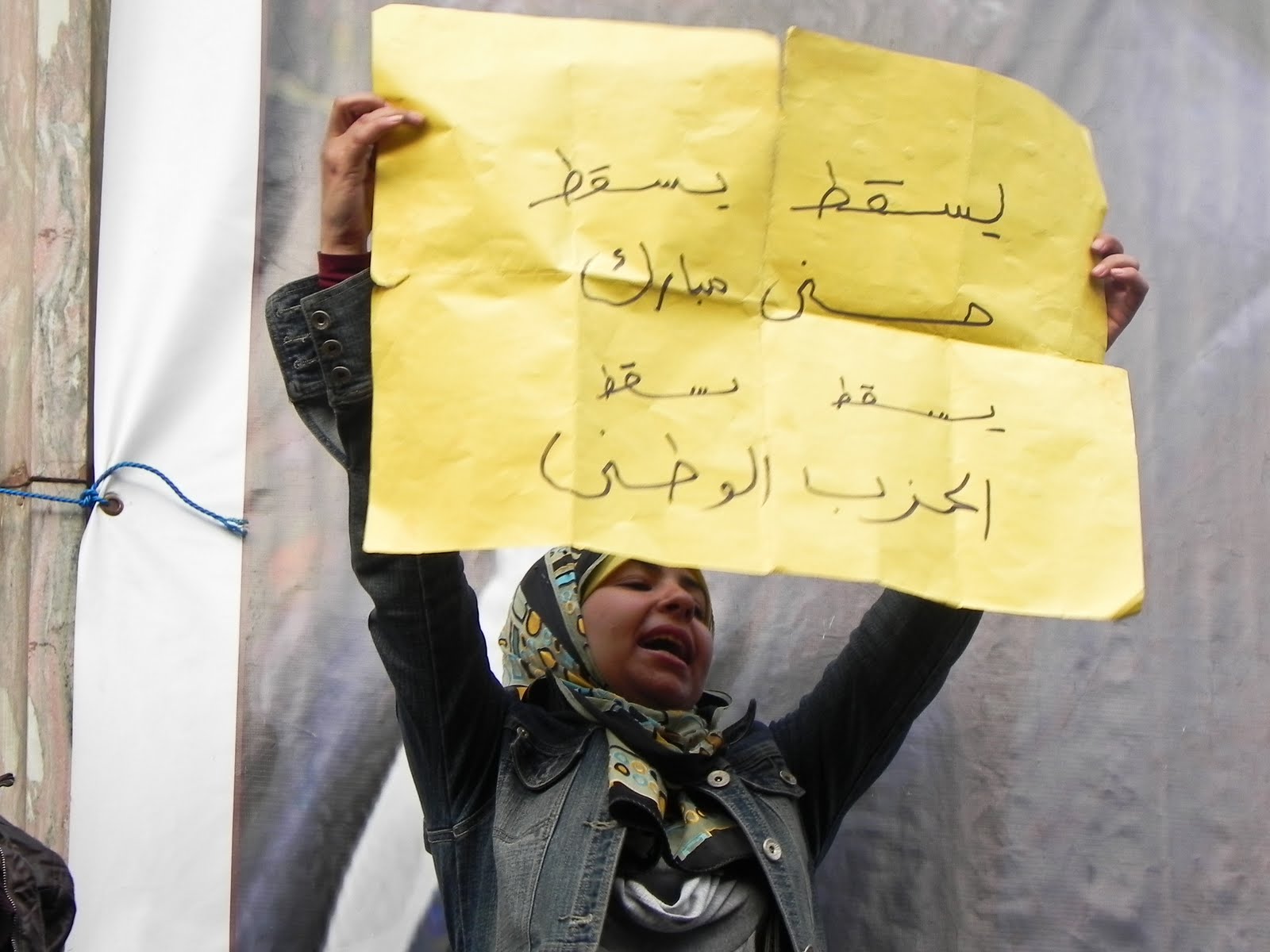 A sense of hope prevails in the streets of Cairo. Hope mixed with fear of how hard the government could crack down and uncertainty over what will happen next, but above all Egyptians have hope that maybe, just maybe, change is coming to Egypt.
For two days Egyptians have taken to the streets by the thousands, astounding both themselves and the world. Many thought the tens of thousands gathered in Tahrir Square on Tuesday night impossible in Egypt. Many thought Egyptians were too apathetic or too terrified of State Security.
On Tuesday, January 25, smaller gatherings converged on Tahrir Square through the afternoon and into the evening. Successive groups numbering from tens to thousands crossed the Qasr el-Nil brigde into one of Cairo’s most vital arteries. “Down, down with Hosni Mubarak!” they chanted.
They wore broad, sometimes giddy smiles.
Groups talked and laughed. Chants against a repressive regime sprouted again and again. Older men, some of whom participated in Egypt’s last great protests in 1977, discussed politics and smoked an endless chain of cigarettes.
Not all was peaceful: security forces hosed protesters with water and shot tear gas into the crowds. After midnight, Tahrir was ruthlessly cleared of any remnant of the day’s events.
Watching demonstrators press on through clouds of tear gas, watching families with young children brave the streets, hearing the raw emotion as Egyptians chant for freedom – one has the feeling of standing on the edge of something truly momentous.
But nothing is certain.
Wednesday, January 26 saw many small, disorganized demonstrations. The lack of communication meant no one knew where to go and most groups were quickly dispersed. It was also clear that no one expected the January 25 protests to be a success, because no one was ready for continued demonstrations on the 26th.
Even so, Egyptians have come to the streets in a way they have never done under Hosni Mubarak. The fear has been broken, and Egyptians are unlikely to give up and go home.
To quote one twenty-something Egyptian, “Tuesday was the happiest day of my life.”
Peaceful demonstrators attacked with tear gas, tasers
I caught this video last night outside Midan Talat Harb at around 9:30pm. Notice the lack of communication/coordination among the police: as two police try to talk down demonstrators, the first round of tear gas is fired from behind.
Tuesday, July 20, 2010
Debating Journalism: Humanity vs. Professionalism

Perched on a rock by the edge of a cliff-side village at sunset, I’m surrounded by a curious group of children. Ranging from about five to nine years of age, they eagerly watch over my shoulder, fascinated by the combination of foreigner, computer, and English. One notices my camera and soon there is a chorus of “Soureeni! Soureeni!” Take a picture of me.
The adults offer to shoo them away, but I don’t mind.
We’re sitting on the edge of the village as an orange and pink sunset colors the sky over the valley below us. Olive trees cover the hillsides, and one-lane roads weave into valleys and over ridges. Clouds move slowly in a heavy sky as energetic 5-year-old Assad is carried off by a smiling father. Within moments he’s back, jumping and laughing and making faces in his sandals and red sweats.
“Mish ‘arfa,” I don’t know, I tell him, and he bursts into laughter before resuming his rapid-fire speech in Arabic.
It’s a comforting way to end a difficult afternoon, with smiles and laughter all around as children and youth and their older counterparts gather to talk with their “international” visitors.
Just a few hours ago I sat down with two young men from this small community in northern Palestine
Mohamed was shot by IDF soldiers in March 2010 as he ran to help another friend who had been shot. Neither boy had participated in the day’s peaceful demonstration against the neighboring Israeli settlement; neither was politically inclined. They were in the wrong place at the wrong time. The soldiers used live ammunition. Crowd-controlling rubber bullets were absent. The deaths were a shock to the community of 800.
As I listened to Mohamed’s cousins and our conversation drifted far from the limits of my story, the boundary between professionalism and humanity shifted, blurred – I knew the intimate testimony would remain between us. It would never be found in an article.
It is not the first time I’ve faced a situation where the line between journalism and friendship blurs. One of the challenges of being a journalist is keeping perspective and humanity at the same time, and it is not a simple challenge.
Humanity is vital. Personal connections are what make stories real – what can bring a tear to a stranger or solidarity from a reader time zones away. At the same time, one faces the dilemma of losing sight of the end goal. An article which captures pain and emotion without describing it as such is that much more powerful for doing so.
The line between journalism and friendship or between professionalism and humanity is not immovable. It shifts. At times it may not even exist. Yet while some rapport between interviewer and interviewee is vital, crossing the invisible line between them is dangerous to both.

Perhaps those with a strong sense of empathy are not meant for what can be a cut-throat profession. Empathy does not lend to cold analysis, which so often seems to be praised. Yet, is not the absence of humanity more dangerous than the alternative?
Wednesday, July 14, 2010
The Old City of Nablus

Colorful fruits and vegetables. Pungent spices. The sticky sweetness of konafa. Shops whose wares of clothes and household goods spill into narrow alleyways. The aromas of falafel, shwarma, and occasionally donkey dung. Calls of “welcome!” This is the Old City of Nablus.
A Turkish bath awaits behind closed doors – for women only, because today is Sunday. Women lounge on cushions or chat at tables. Some sip cups of tea with mint or Turkish coffee, others puff away at flavored tobacco or shisha, the water-pipe known by a dozen names and common throughout the Middle East . Behind closed doors are hot stones under vaulted ceilings, mosaic walls, and steam rooms, the last of which is barely discernable through the clouds of water vapor billowing out of it. This is the Old City of Nablus.

Yet the doorway to the Turkish bath is not so grand as it once was. A closer look at the alleyways reveals countless posters commemorating martyrs and patches of crumbling stone. Above the smiling faces of shopkeepers and curious eyes of children, bullet holes riddle the sides of buildings which have yet to be restored. Some of the holes are decades old, others only a few years. This, also, is the Old City of Nablus.
Today is a normal day in the Palestinian city. The violent conflicts of the Second Intifada are no longer daily occurrences, but they are far from forgotten. The martyr posters commemorate the men, women, and children Nablus Nablus was strictly controlled, with students of An-Najah University
Reminders of the conflict are easy to see, and one doesn’t always have to look hard for them. In a handful of shops, ammunition belts and bullet-proof vests hang beside keffiyehs and baseball caps.

This, too, is the Old City of Nablus.
Tuesday, July 13, 2010
Refugees, tear gas, and culture
Here's a brief update of the last few days. More later.
Yesterday we took a tour of the Balata Refugee Camp and Yafa Cultural Center. Balata was formed by the United Nations for refugees from Yafa and the surrounding areas of Palestine in 1951. It was intended to be temporary, and was located on one square kilometer of land in the Balata neighborhood of Nablus.
Today, the camp is still there, and over 25,000 people live in its one square kilometer.
This morning we took a bus down to Ramallah for a meeting at the headquarters of the Stop the Wall campaign. After that, we went to the village of Nilin. Nilin is one of many villages of farmers who have found themselves separated from their land due to the wall being built by Israel to separate the West Bank. As we walked about a kilometer away from the wall, we were constantly stepping around empty military-grade tear gas canisters. The cacti lining the dirt road were riddled with bullet holes. In some places rubber bullets remained embedded in the plants. Rubber bullets and regular shell casings weren't hard to find on the ground.
Reaching within half a kilometer of the wall, our local guide stopped us.
"What will happen if we go closer?" asked a member of our group.
"I don't know," he replied. "Maybe they will open the gate and shoot us."
We kept our distance.
We also ran into a peacock as we walked back into the village, before we headed to the Palestinian Popular Culture Center. Go figure.
Saturday, June 12, 2010
Brutal death of young Egyptian raises questions

Egyptian bloggers and independent and opposition media have been widely publicizing the death of 28-year-old Khaled Said over the past few days.
Last Sunday, June 6, 2010 Khaled died. According to most interpretations of the story, Khaled was brutally murdered by two plainclothes police officers who confronted him in broad daylight at an Internet cafe in Alexandria. This article in the New York Times reports that according to Khaled's family the young businessman was killed because he was in possession of a video which clearly showed the two officers who assaulted him dividing the spoils of a drug bust amongst a group of people including themselves (the video can be viewed here). The article says:
The officers slammed [Khaled's] head against a table, dragged him outside, smashed his head against a metal door and continued to beat him even after he was dead.
Ahmed Badawy, an Egyptian activist and acquaintance of mine, went to the Internet cafe on Friday and interviewed its owner. The owner revealed that Khaled had been clearly targeted by the men who assaulted him, who blocked the doors of the cafe to prevent anyone entering.
Khaled's body was dumped outside his home later that evening.
The government's position:
The official statement from the Egyptian Ministry of Interior calls the story a "malicious allegation" which may "deliberately omit all the facts and persist in promoting lies and misinformation." The statement says Khaled swallowed a bag of narcotics and consequently died of asphyxiation. It also reveals that Khaled had been charged with two misdemeanors, stealing and possession of a weapon, in addition to harassment of a woman and dodging military service (compulsory in Egypt). Egyptian activists have questioned the reality of the charges.
The Ministry's statement does not address the dumping of Khaled's body outside his home, nor does it explain the disturbing images of his mangled skull. The images, which are extremely graphic and should be viewed with discretion, have been widely circulated and can be found here.
An article in government-run Al-Gomhuria insists the injuries to Khaled's face were caused during autopsy when his throat was cut open to remove the packet of hashish he had swallowed. The article calls the images' appearance on Facebook a "big surprise." It is a difficult explanation to accept after viewing the gruesome images.
Popular outcry
"If you oppose the government in Egypt, one of three things happens: one, you disappear. Two, you end up dead. Or three, you disappear and then you end up dead," an Egyptian friend cynically commented to me in casual conversation one day. To an extent, Khaled Said's story fits the model - and consequently is no different from others.
Yet Khaled's story is also fundamentally different.
Khaled's story has been publicized. Khaled "died amidst the shock and silence of everyone," wrote Ayman Nour on Thursday. Nour, along with Egyptian paper el-Shorouq, was the first to break the story nearly four days after Khaled's death. Since then, it has flooded Egyptian activist circles, independent media, and Facebook inboxes. There is no longer silence surrounding Khaled's death.
The incident has drawn an outcry from Egyptians, including many who are normally inactive in politics. A Facebook group called My Name is Khaled Mohammed Said has drawn more than 110,000 members over the past three days - the group grew by nearly 3,000 members in the time it took me to write this post - and an event calling for a protest in front of the Ministry of Interior on Sunday, June 13 has nearly 5,000 confirmed attendees.
Scores of Egyptians have changed their profile pictures to images of Khaled, such as the one at the top of this post.
A protest yesterday in Alexandria drew around 1,000 people according to blogger and activist Mohamed Abdelfattah, who attended the protest, and well-known blogger Zeinobia says police dared not come close to the demonstrators for fear of increasing their anger.
"This could happen to anyone."
Despite a general consensus that Egyptian police were responsible for his death, Khaled's story still falls outside my friend's generalization: Khaled was not political. According to the New York Times article, Khaled was intent on publicizing the video he had come to possess, but he was not an activist. He was not opposing the government.
Khaled walked beside the wall, as an Egyptian would say, referring to one who minds his own business.
Despite "walking beside the wall," Khaled was killed by a police force imbued with the power of the Emergency Law, a cause of concern for other young Egyptians. "He didn't look for trouble, yet corruption killed him anyway," said my friend Hatem, a 22-year-old Egyptian currently studying for his Master's degree. "Maybe they've done worse things before, but this directly threatens me: this is a young guy who comes from almost the same background as me and most of my friends. He does the same things that I do. He stays out of trouble. And yet - this. You know?" he told me.
For Hatem, Khaled's death means "this could happen to anyone."
Questions which remain
Nearly a week after Khaled's death, many questions remain. How did Khaled come into possession of the video for which he was supposedly killed? The video was clearly filmed by someone trusted in the room, someone who almost certainly was not Khaled. So was he given the video, or did he somehow happen across it?
What will the government's response be? Will the officers in question be charged with corruption, if not murder? Or will they walk away unscathed? According to a post by Mohamed Abdelfattah, this was not the first act of brutality committed by one of the men who assaulted Khaled (please note, link contains graphic images).
It would seemingly be easier to let the officers take the fall for Khaled's death in the face of the current media onslaught, but there has been no indication thus far that the government intends to make such a move. Why is the regime letting Khaled's death become a rallying point, instead of meting out some form of justice which might placate activists? In some ways this is only the most recent incident hinting at growing discord within the regime.
Khaled's death is drawing attention. What will Egyptians do about it? There have been calls of "revolution" since Kefaya's first demonstration in 2005, but the said revolution has yet to materialize. Even so, 2010 has seen increasing numbers of protests and increasing numbers of protesters. This week, Egyptians already angered by Israel's assault on the aid convoy headed for Gaza quickly took up the cause of one of their own. If Alexandria's demonstration was any indication, tomorrow's protest in Cairo could bring thousands of Egyptians to the streets.
What's next, Egypt?
For more information in English, please visit:
Tuesday, April 13, 2010
Another protest...
More later, but here's a brief for now:
- Around 1,000 protesters showed up - pretty impressive number
- Reps of: Kefaya, al-Ghad, April 6, Karama, National Association for Change, + others
- Multiple protesters were pulled out of the security boundaries by police and beaten
- More of the political elite present: Ayman Nour, George Ishak, Hamdeen Sabbahi, and other MB/ Socialist/ liberal leaders
- ElBaradei nowhere to be found, as usual
- Ayman Nour and al-Ghad Chairman bodily pulled an unconscious protester from under the feet of police
- Complaint of police brutality taken directly to a judge by Ayman Nour and others
Will give you a more comprehensive report later.
UPDATE (14/4): I would like to clarify a few issues from yesterday:
UPDATE (14/4): I would like to clarify a few issues from yesterday:
- First, Ayman Nour's son was NOT harassed OR beaten by police. These rumors resulted from a misunderstanding and despite being widely promoted via Twitter and other means they are NOT true. Noor is perfectly fine and safe.
- Bahaa Sabr, who was arrested yesterday and beaten severely by police, is currently in the hospital. Twitter story confirmed by multiple bloggers, although it has yet to be reported elsewhere.
Thursday, April 8, 2010
April 6, 2010: Ayman Nour's Commentary and Call for Solidarity
Ayman Nour recounts the events at al-Ghad headquarters on April 6, 2010 and calls for solidarity from the international community:
Tuesday, April 6, 2010
My run-in with Egyptian state security
Today I witnessed a fraction of what Egyptian activists face.
As our taxi neared Talat Harb street, the government's preparations were obvious. Uniformed police lined the streets. Large green military trucks were parked end to end on side streets, as many as eight in one place, each full of soldiers. The atmosphere was already tense.
Today is the second anniversary of the April 6, 2008 protests, which were the first simultaneous nation-wide protests in Egypt. The 6 April Youth, who became known after the protests, planned another strike for today. It was supposed to be a peaceful protest march from Tahrir Square to the Egyptian Parliament a few blocks away.
The Government was ready and in no mood to deal with protesters.
Another American journalist and I met at Ayman Nour's apartment in Zamalek at 10am. As we prepared to head downtown, one of Nour's people gave us a few suggestions: don't wear gold jewelry, and memorize someone's number in case you are arrested and they confiscate your phone. I rolled up my sleeve and wrote a few numbers - without names - on my arm. My friend did the same. My roommate and her roommate - non-political friends - and my editor.
 |
| Police standing outside the Journalists Syndicate in downtown Cairo |
Our initial destination point was the al-Ghad party headquarters on Talat Harb street. Before going to the headquarters, however, my companions and I decided to take a look at what was happening in Tahrir.
At around 11am we were walking from Talat Harb through Tahrir Square in downtown Cairo (where the Egyptian Museum and the American University are located). My friend and I stayed a dozen meters in front of our al-Ghad friends, figuring we would have more freedom to snap pictures as 'tourists' if we weren't associated with them.
As it turns out, that wasn't really the case.
I snapped a few pictures of the police lining Tahrir as we entered the square and then turned my camera off. My friend panned her camera around the square and toward the police. Suddenly, three angry men were coming straight toward us. It was immediately clear that these were plain-clothes security, and they were not happy.
 |
| Riot police in Tahrir Square |
"Give me your camera," said the man in charge. "Give it to me. Let me see." He roughly grabbed my friend's camera, trying to pull it away from her.
"You can't do that!" She said, pulling away from him.
In the few seconds the exchange took, we were surrounded by plain-clothes security. One grabbed my arm, attempting to pull me away from my friend, while the first attempted to pull her camera away again. She held onto her camera and I held on to her, and we tried to walk away. Security blocked our path. "I'm an American citizen! You can't do this to me!" my friend shouted. The security pressed in closer. "Somebody help me! I'm an American citizen!" We were drawing looks from passerby. One of the security men waved his arm and we were completely encircled.
After a few intense minutes of arguing, we were ushered against the wall of the building behind us (Hardees). We were less conspicuous there, but we were still making a scene and the police were not pleased.
They also didn't believe a word that came out of my friend's mouth. They weren't terribly interested in me, possibly because they hadn't seen me taking pictures, but they interrogated my friend endlessly. Where are you from? What is your job? Why are you here? They didn't believe her story - that she was a student and happened to be in the wrong place at the wrong time (later, when we saw the same security men in a coffee shop around the corner, the head man said flatly to my friend: "You are a liar").
Finally a female security officer in uniform came over (this is the first time female officers have been deployed during a protest, and later in the day they proved just as brutal as the men). She went through our bags piece by piece. The first man had already taken a copy of my friend's passport (which we never saw again), but I had no identification on me. Looking back, I'm glad - they don't know who I am.
The whole time, my friend had been on the phone with our al-Ghad friends and others, letting them know that while we were being detained, we would be okay. Whatever happened, we did not want our al-Ghad friends to show up: if they did, our story about being in the wrong place at the wrong time would be shot. As it was, the officers were demanding to know who we were on the phone with. "Who is Badawy?" they demanded.
After another ten minutes or so, another plain-clothes officer arrived. He was better dressed and clearly had more authority than the officers who had been dealing with us so far. He was smiling as he ambled over.
"What is the problem?" he asked.
"I've been all over the world, and I've never had problems with the police!" fumed my friend.
"You still don't have trouble with the police," said the man, still smiling amiably. At this point I was shaking, half from nerves and half on purpose. He looked directly at me. "Why are you frightened?" he asked.
Eventually he 'explained' to us that there were demonstrations, and it was a security matter that we weren't allowed to take pictures. After a few more minutes of this back-and-forth, someone said, "okay okay, come this way." We were ushered around the corner onto another street, and when we looked behind us we realized we were no longer being accompanied by security. We were free to go, it seemed.
Needless to say, my friend and I were a bit shaken up. Our encounter with the police had been pretty intense.
What we faced was only a small taste of what Egyptian activists face: as Americans, the regime is less likely to physically harass us.
Even so, we knew going back to the protest was going to be a bad idea. We finally made the decision not to go back into Tahrir. We considered moving to the al-Ghad headquarters, but my friend had a bad feeling about it, and luckily we went with her gut: around the time we would have arrived, there was a confrontation with state security outside the headquarters when Ayman Nour and his supporters attempted to leave the building. They were eventually forced back inside and the door was barricaded for over three hours, with no one allowed out. Ayman Nour's eldest son was briefly detained by security, and the scratches and bruises on his neck are a testament to the way he was manhandled by the plain-clothes officers.
 |
| Noor Ayman Nour, eldest son of Ayman Nour, arrested near Talat Harb. Photo by Al-Jazeera. |
It's too soon to really say if the day was successful or not, but... here are some thoughts and facts:
- Over 80 persons were arrested and moved to the police station in Nasr City.
- There were violent confrontations between police and protesters in Tahrir and also outside the parliament; there were even female police beating female protesters, and two women sustained broken arms.
- More than 70 people were locked inside al-Ghad headquarters;
- Violent clashes occurred in Alexandria;
- Mobile phones and gold jewelry were confiscated by security around the parliament;
- ElBaradei was completely absent from the scene, and there is a possibility that this will hurt his reputation here. Already there has been much criticism on both Facebook and Twitter.
I'll get back to you on some of this soon... there's so much I want to say, I don't really know where to begin.
Subscribe to:
Posts (Atom)