Showing posts with label January 25 Revolution. Show all posts

Friday, February 3, 2012

In Egypt, conspiracy theories sometimes have merit

Armed bank robbery. Scores killed in a football brawl. American tourists kidnapped.

One year after the uprising that sparked national pride and hope in Egyptians, the wave of unprecedented incidents – as well as renewed clashes between demonstrators and police in downtown Cairo – has many asking: What is happening, and why?

Many believe the incidents of the past few days are anything but coincidence, and with reason. Just days before masked gunmen robbed the HSBC bank in New Cairo, an upscale Cairo suburb, Egypt’s de-facto ruler cancelled the country’s three-decade-old Emergency Law.

Put into effect in the wake of late President Anwar Sadat’s assassination in 1981, the series of laws prohibit more than five persons from gathering in one place without prior permission and allow search and seizure without a warrant, among other things.

The first armed bank robbery in modern Egyptian history occurring just after the cancellation of the law seems unlikely to be pure coincidence.

And despite an age-old rivalry between Cairo football team al-Ahly and Port Said team al-Masry, Egyptians refuse to accept that mere team rivalry is to blame for the 73 deaths after Wednesday night’s match in Port Said.

Many have questioned the inaction of the country’s hated Central Security Forces, who stood by and watched the violence instead of intervening to stop it. One match-goer said he and others were not searched by security upon entering the stadium, perhaps explaining how some al-Masry fans were able to enter the match with knives.

The real question is whether recent events are an honest representation of Egypt without the Emergency Law or whether someone – the ‘who’ is as always unclear – is orchestrating events.

One theory is that the government or the ruling military council – in power since former president Hosni Mubarak stepped down in February 2011 – is stirring up trouble as an excuse to reinstate the Emergency Law. Removing the law was one of demonstrators’ primary demands during the 2011 uprising, and remained a source of contention as the military continually delayed its repeal.

Others blame the ubiquitous “foreign hand.” One theory reported on state television today was that the ongoing clashes in downtown Cairo are a US-German plot in retaliation for the Egyptian government’s raid on a series of foreign NGOs earlier this year.

Both suggestions may sound like conspiracy theories, but in Egypt conspiracy theories are selcdom as impossible as they seem.

In one example, documents “liberated” by Egyptians citizens during the so-called Amn Dawla Leaks last spring revealed former Interior Minister Habib al-Adly was involved in the New Year’s Eve bombing outside an Alexandrian church that shocked the country.

The government had tried to pin the incident on an al-Qaeda faction based in the Gaza Strip.

Today images of clashes between demonstrators and police glare once more from television screens. The upraised arms of demonstrators and the unfaltering wave of an Egyptian flag can be seen through a foggy haze of tear gas. Both sides throw stones, and the wail of an ambulance occasionally cuts through the dull roar of the clashes and the television presenter’s voice.

The images are painfully and eerily reminiscent of earlier clashes: the battle of Mohamed Mahmoud in November 2011, the June 28 clashes, and, perhaps most poignantly, the infamous Battle of the Camels.

On February 2, 2011 Egyptians watched and lived in horror as men on horses and camels and wielding clubs and machetes attacked what for nearly five days had been a peaceful demonstration in Tahrir Square. Yesterday, exactly one year later, the current clashes began, sparked by the deaths of more than 70 people at a football match.

Public opinion is sharply divided.

“This had to happen,” said one young Egyptian, watching the images today on the television in a small town an hour outside Cairo. “The revolution has to continue.”

Others fear the economic impact of continued clashes.

Sunday, January 29, 2012

Egypt's Day of Rage as I saw it - Video


Video compilation of clips from Friday, January 28, 2011 in Cairo's Abdel Moneim Reyad Square, just steps from the now-iconic Tahrir Square.

Wednesday, January 25, 2012

#Jan25 - One year later

One year ago today, I stepped out of a taxi in Mohandiseen and stared in disbelief: hundreds of demonstrators were gathered across the street. In that instant, I knew the January 25 demonstration would be different. I knew it wasn't the usual - demonstrators outnumbered by police in some out of the way location. I knew something had started.

Today is the one-year anniversary of that first demonstration that set the pace for Egypt's 18-day uprising, which topped 30-year ruler Hosni Mubarak from power and, more importantly, renewed Egyptians' pride in their country and hope for a better future.

Today, Cairo's iconic Tahrir Square was packed hours before marches were set to converge on the square.

Men, women and children thronged around various stages set up in the square. They chanted for the freedom of Egypt and the fall of the military council, which has administered Egypt since Mubarak resigned on February 11, 2011. Vendors carried food, drinks, sweets, and memorabilia of all kinds.

By 10am, it was clear that January 25, 2012 was to be a giant celebration for Egyptians.

Foreigners who have made Cairo their home also gathered in the square. One British woman had brought her two young daughters. Their small faces painted with Egyptian flags, the girls stared around them wide-eyed as Egyptians asked their mother to take pictures with her children.

The younger one refused, instead opting to take pictures herself.

Monday, January 23, 2012

Tuesday, January 17, 2012

Jan 17, 2011 - Whispers of a demonstration

One year ago today, 49-year-old restaurateur Abdou Abdel Moneim Gaafa set himself ablaze outside the Egyptian parliament. A stark reminder of the young vegetable seller whose self-immolation weeks earlier catalyzed an uprising in Tunisia, the question inevitably arose: will this be Egypt’s Mohamed Bouazizi?

Egypt remained silent.

“Some… predict Tunisia is but the first of the tyrannical [Arab] regimes to fall,” I wrote at BikyaMasr.com on January 17, 2011. “Others see little chance that Egyptians, typically apathetic when it comes to politics, will be stirred to action.”

There was talk. Analysis. Articles in newspapers – but no revolution. No uprising. Not even one single demonstration.

The next day I wrote, “Egyptians are still too afraid of their government and its security forces… to go to the streets in the numbers that a revolution requires.”

After a year of watching Egyptians’ apparent inability to act, I was already somewhat jaded. I suggested that Gaafa’s act would join Khaled Said on a long list of painful sores for the Egyptian people, but would not be enough to stir action.

Three nights earlier Zine el-Abidine Ben Ali had fled Tunisia. I was at an Open Mic in Cairo when the news broke. The crowd buzzed. In between performances there were whispers of, “Did you hear??” and “Is it true?!”

Some couldn’t peel their eyes from Twitter applications or frantically searched for news updates on their mobile phones. Others – including myself – relied on text message updates from friends following the news at home.

Young people in my circle of friends were frustrated, but many more remained apathetic even as they praised Tunisians’ courage.

“No one will move,” wrote one young Egyptian woman on Facebook. “We are not Tunis.”

It seemed she was right. Egyptians were angry – at their government, at their police, at growing inequality, at their own inaction – but it seemed they were not yet angry enough.

I remember so well the frustration, the yearning in the voices of my friends as they talked about Tunisia and how they wished Egypt would be next. Even the boldest and most optimistic hardly dared to dream that Egypt would rise up - but they did dream. They dreamt and they talked and they planned, and there were whispers of a demonstration on January 25.

And then, just one week later, Egypt rose in all her glory and fury.

Thursday, January 12, 2012

New series: Looking back at Egypt's revolution

One year ago today I wrote one of my favorite blog posts – Spiced tea, social norms, and me. One year ago today, no one was talking about politics. I, the young foreign journalist, was the one explaining to my Egyptian friends the requirements to run for president and what, exactly, the Emergency Law said.

One year ago, it would have been unthinkable to sit in a trendy Cairo café and find BBC Arabic on the television.

It’s amazing how much can change in a year.

Outwardly, it’s easy to overlook the changes. In many ways, things seem to be as they always were. The traffic is as bad as ever, young people still have to go to school and take exams, there’s still sexual harassment on the streets. The blog post I wrote last year about social norms I could write again today.

Yet many things have changed. There are Egyptian flags everywhere, every Egyptian knew when parliamentary elections were happening, and the cover of state-run Al-Ahram newspaper doesn’t boast a picture of three-decade ruler Hosni Mubarak on the front page every morning.

A year ago, the only people talking about a ‘revolution’ were those watching Tunisia and the handful of Egyptians who, some for months and others for decades, had been trying to bring political and social change to Egypt.

Among them were the April 6 Youth Movement, the Kefaya Movement, Sheyfenkom, and We Are All Khaled Said. There were individuals, as well – popular public figure Gameela Ismail, journalist Hossam al-Hamalawy, and young activists such as Asmaa Mahfouz, Israa Abdelfattah, and Ahmed Maher.

Now there are a thousand more names: Wael Ghonim, Ramy Essam, Alaa Abdel Fattah (a long-time activist, but only recently well-known), Amr Hamzawy.

On January 25, 2011 I stood in Tahrir Square with Hamalawy. He told me he always knew there would be a revolution.

Over the next few weeks, I intend to post a series looking back on the revolution, its aftermath, and its future. Whether you're looking for more insight into the events surrounding the revolution, a different perspective, or just want to revisit those earth-shaking 18 days, I will show you Egypt's revolution through my eyes.

I will share with you how I crossed paths with names both big and small – Ayman Nour, Mohamed el-Baradei, and many others. Look forward to text, pictures, video, and sound bites of Egypt's January 25 Revolution.

Tuesday, October 18, 2011

To tell the story of Egyptians with humanity

I'll be honest: sometimes I wonder why I'm a journalist in Egypt.

Cairo is a dirty, polluted, crowded city. The streets are littered with trash; sand incessantly finds its way into my living room; my family is six timezones away. Everyone is always late, it's impossible to get sources to answer their phones, and Tweeps are more reliable fact checkers than state media.

Last night, for the first time in a long time, I was reminded why I bother: it's because I want to tell the story of the Egyptians. It's because of the never-ending Egyptian humor; the smiles in the face of poverty; the perseverance in the face of persecution. It's because of the slow, steady determination that has kept Egyptians and the Egyptian identity intact over millennia, through invasion, occupation, and oppression.

It's because Egyptians inspire me.

Last night BBC correspondent Lyse Doucet spoke at a gathering of Egyptian and American journalists in Cairo. Her frank speech moved me - and others - nearly to tears. She spoke of objectivity; of obligation; of what it means to be a journalist in a conflict zone. She reminded me why I am a journalist, here and now, and why I care about reporting on Egypt.

"When you cover a happy story, cover it with joy," she said. "When you cover a sad story, cover it with compassion."

To be objective does not mean to be heartless. A good journalist must write with humanity.

I've often wondered what, exactly, is my role - as a foreigner and as a journalist - in Egypt. Both foreigners and Egyptians have told me I don't belong here, and both foreigners and Egyptians have told me I tell the story better than anyone else. I've written before about the line between professionalism and humanity, and that's something that comes to mind again and again.

Before Egypt's January uprising, as a foreigner, I was looked upon with suspicion. As a foreigner, I was thanked profusely. After Egypt's January uprising, as a foreigner, I am looked upon with suspicion. As a foreigner, I am thanked profusely.

It's a bit strange sometimes.

As a journalist, I am obligated to tell the truth as I see it at the time. I am obligated to tell both sides of the story. I am obligated to be objective.

But on January 26, 2011 I watched as a group of young men - unarmed, with their hands in the air as they chanted peaceful, peaceful - were without warning attacked with tear gas, tasers, sticks, and firearms by both uniformed and plainclothes police in the streets of downtown Cairo.

What is the other side of that story?

I don't know.

So what can I do, as a foreign journalist in Egypt? I can write. I can tell the truth, and I can tell it with joy and compassion, which so often seems to be lacking from mainstream media. I can tell the stories of a people and a place that have become dear to my heart, and I can do it in a way many other journalists either cannot or will not.

I've been told I have a way with words. I've been told I can draw people into my writing. I can use that way with words, coupled with common sense and a solid understanding of Egypt's politics and people, and I can tell the story of Egyptians.

That's why I'm a journalist in Egypt.

Thursday, July 21, 2011

Decision to remove Mubarak's name from public buildings overturned


A ruling to remove the name of ousted Egyptian president Hosni Mubarak from governmental buildings was overturned by a Cairo appeals court today.

The court that issued the decision in April acted beyond its jurisdiction, said the Cairo Appeals Court for Urgent Matters. The case has been sent to the administrative court.

Supporters and opponents of Mubarak reportedly clashed outside the courthouse after the ruling was announced.

Mubarak’s name, and that of his wife Suzanne, was prominent on public buildings from schools to hospitals during his 30-year term as president of Egypt.

A metro station named for him was quickly renamed to ‘the Martyrs’ in the aftermath of the popular uprising that toppled Mubarak from power in February.

Popular opinion has insisted that Mubarak’s name be removed from everything from the metro stop to neighborhoods. Taxi drivers in a Sharqiya town refused to drive into the ‘Mubarak’ neighborhood earlier this year, demanding the neighborhood be renamed 'Martyrs' first.

Egypt's octogenarian former leader is set to go on trial August 3 for murder of demonstrators and corruption.

This post was originally published at Youm7 English Edition (offline as of Jan. 2011).

Monday, June 13, 2011

Why the international media gets Egypt wrong

An article by the Associated Press today began, “the long banned Muslim Brotherhood has been recognized as the Freedom and Justice Party.”

That’s not quite true.

What the article means to say is that the Freedom and Justice Party, founded by the long banned Muslim Brotherhood, has been recognized.

The difference is significant.

While Egypt’s political scene has accepted the Muslim Brotherhood as a legitimate actor, the organization which has been banned for decades is still, officially, banned. The Freedom and Justice Party was indeed founded by the Brotherhood and in the party the Brotherhood has its first legal political entity.

However, the party does not exclusively contain Brotherhood members, nor are all members of the Brotherhood automatically members of the party. According to one of the party’s founders, 25 percent of its members are not affiliated with the Brotherhood. What’s more, around 8 percent are women and Coptic Christians.

It remains to be seen how the party’s relationship with the Brotherhood will play out, but technically the Associated Press got its facts wrong.

This is only one small example of the international media’s frequent mistake when it comes to Egypt and the wider Arab world: they see only the surface and do not know, or do not understand, the nuances.

The problem is twofold: first, manpower and resources. Second, the target audience is, usually, not the Middle East.

The issue of distributing resources is something all newspapers and news agencies must come to terms with. International agencies must cover the entire world and consequently cannot devote too many resources to any one area. That said, the entire world is watching the Middle East now more than ever and consequently it is more important to get the facts straight than ever before. Small slip-ups could have far-reaching implications.

The second issue is arguably more important. News agencies want their stories to be understandable. It is one of the fundamental principles of journalism: convey your story to your reader so they understand what you’re talking about. But oversimplification to this extent does not help anyone. It certainly does not help the “West” understand the Arab world.

Journalism’s goal is not to defeat misperceptions, but the international media must learn to balance the simple goal of telling the news with a more complex duty to portray more than the surface of its subject.

When it comes to the Arab world, too often foreign media takes the easy road: they report what they see with their own eyes and talk with people it’s easy to talk to. Namely, other journalists and people who speak their language or are of their own social class.

Watching coverage of the Egyptian Revolution in the United States, many Americans thought to themselves, “Hey, it looks like America succeeded in Egypt. Everyone speaks English.”

Those reporting the world-changing events taking place in Cairo’s now-iconic Tahrir Square made the vital mistake of interviewing predominantly English-speaking Egyptians, probably because it was easier.

In the short-term such reporting may be easier. In the long-term, however, this sort of reporting misses what’s actually happening on the ground; it misses the opportunity to portray a different culture and a different way of thinking in a way its target audience – in this case, the Western world – can understand.

This is why the international media consistently gets Egypt wrong, and probably part of the reasons misconceptions about the region continue to prevail. It is no longer acceptable to skim the surface and write the easy story – if it ever was. The world does not only want the surface news. The world wants to understand Egypt.

This article was originally published at Youm7 English Edition on June 7, 2011.

Tuesday, June 7, 2011

Remembering Khaled Said

Some would argue his death started a revolution – or at the very least was one of its major catalysts. Khaled Said is still burned into Egypt's memory a year after his brutal death.

Today Egyptians gathered in Cairo, Alexandria and Fayoum to remember Khaled.

While the exact details continue to be disputed, Khaled was killed at the hands of Egyptian police in Alexandria on June 6, 2010. He was beaten to death and his body was dumped his home. Four days later his story spread rapidly across the internet after prominent opposition politician Ayman Nour publicized Khaled’s death and pictures of his mangled face.

Egyptians were outraged. Protests were organized. In Khaled’s home city of Alexandria, men and women stood along the corniche, the road separating the city from the Mediterranean Sea, every Friday afternoon. They dressed in black. They carried the Bible or the Quran, and they prayed silently for Khaled’s soul.

Stark images of educated, upper-middle-class youth stretching down the corniche drew more attention. These were not the small, violent demonstrations Egyptians were accustomed to. Those attending actually had something to lose.

Yet Khaled was not the first to die at the hands of Egyptian police. There were many before him. So why did Khaled Said, a 28-year-old businessman, draw millions of supporters to a Facebook page within days? Why were weekly demonstrations organized in Alexandria and Egypt’s capital, Cairo, for months after his death?

Ultimately, the answer is simple: Egypt’s politically inactive middle class considered him one of their own.

Shortly after news of Khaled’s murder was made public, an Egyptian friend told me why he – an upperclass Egyptian who wasn’t involved in politics and had the money for a good education – was so affected by Khaled’s death: “He didn't look for trouble, yet corruption killed him anyway. Maybe they've done worse things before, but this directly threatens me: this is a young guy who comes from almost the same background as me and most of my friends. He does the same things that I do. He stays out of trouble. And yet, this.”

My friend, like many other Egyptians, believed he could be next.

While some of those who publicized Khaled’s case were seasoned activists, many more were not. For the first time, portions of Egypt’s middle class went to the streets in public demonstrations – perhaps the most politically repercussive aspect of Khaled’s death.

In the earliest days of Egypt’s January 25 Revolution, the people taking to the streets were not underpaid laborers or career activists. They were Egypt’s educated middle class, and the first time they had gone to the streets was after Khaled’s death. There were chants for better wages and economic issues, but the calls for democracy, freedom, and human rights were louder. It was, in the beginning, not a bread uprising but a call for what many have termed the “Western” ideals of personal freedom.

The career activists and the politicians were there as well, but they were outnumbered by ordinary Egyptians. Soon the economic demands came. A wave of labor strikes has hit Egypt in the wake of the revolution. Now, people believe they have the right to make their demands heard.

Khaled’s death did not cause the Egyptian revolution. According to a recent poll by the International Republic Institute his death was not even a major motivating factor for Egyptians to participate in or support the revolution.

Khaled’s death was important in a different way. It catalyzed a realization among Egypt’s middle class, who could afford their basic needs: they were no longer safe simply by staying out of politics. For the first time, many decided long-term benefits of going to the streets outweighed the short-term risks.

Now, a year after his death, Egyptians remember Khaled. He is remembered not only as a martyr of the former regime, but as a symbol for everything Egyptians have lost and everything they stand to gain: the rights to life and liberty.

Monday, May 23, 2011

Egypt youth say NO to the SCAF

The Supreme Council of the Armed Forces (SCAF) has been in charge of Egypt’s administration for 101 days.

Today, Egypt’s young revolutionaries are calling for Egyptians to fight the army-imposed media blackout of the military. They have called on Egyptians to blog, tweet, and post anything which breaks the silence on the military’s violations of human and civil rights. They are trying to create a united front in an attempt to open the scene to frank discussion of the military, and to stop what they see as the military’s escalating violations.

Hundreds of Egyptians have answered the call. Twitter is bursting with tweets and posts tagged with ‘#NoSCAF’ about the military, its violations, and what should happen next.

Activist Mona Seif, one of the first to call for the ‘NO SCAF’ campaign, tweeted early this morning: “Waking up to an internet flooded with posts exposing #SCAF is just amazing.”

“If the SCAF wants to ‘punish’ us for ‘criticizing the military’ and ‘spreading rumors,’ then they will have to arrest hundreds of netizens,” wrote Egyptian activist Ramy Raoof via Twitter.

Journalist and blogger Mohamed Abdelfattah said, “Today the Egyptian blogosphere sends a message: WE ARE NOT SATISFIED WITH THE MILITARY COUNCIL.” He has also compiled a list of blog posts against the SCAF: as of 2pm, 140 bloggers had written posts against the military council.

“Blog. Tweet. Post. Be Free. Evaluate the #SCAF today. This is being documented,” tweeted Ahmed Abdulhassan.

Indeed, an Al-Jazeera English producer tweeted in the morning that he was compiling an article about today’s campaign. The tweets of Mosa’ab Elshamy are among the tweets he plans to include. Mosa’ab was arrested by the Egyptian army last week and only recently released. His tweets about what he witnessed in custody are poignant, disturbing, and certainly revealing.

Egyptians have entered what is likely to be a long war, of which the fall of the Mubarak regime was only one battle.

It is a war in which the uniforms are ambiguous, observers are constantly switching sides, and the majority of the combatants have no idea what the strategy is, or, indeed, who it is they are fighting.

Many are fighting undefined notions of the “former regime” or the “counter-revolution.”

Among the most ambiguous players on the scene is the Egyptian army. Hailed as saviors by the vast majority of Egyptians when they swept into Cairo on January 28, ending a long 'Day of Rage' of bloody battles between the police and the people, the army was then charged with the country’s administration when former president Hosni Mubarak stepped down on February 11.

Immediately some began to wonder if the military – and its Supreme Council of the Armed Forces (SCAF) – would ever give up power. They wondered if, in fact, the SCAF would attempt to turn a true people’s revolution into a military coup d’état.

The army has now been in power for 101 days. Each day, mistrust has grown between the people and the army.

Stories of human rights abuses by the army are increasing. Citizens are calling out more frequently to end military trials of civilians. And most of Egypt’s young activists are well aware that Egyptian media is forbidden to write anything about the military without permission.

Yesterday, the SCAF released a statement on its Facebook page – created to communicate with the Egyptian people – saying unidentified websites were publishing false information about the army in an attempt to fuel chaos in the country and to divide the army from the people.

(The fact that the army releases all of its communiqués via Facebook is a story in and of itself.)

Egyptians have faced battle after battle in their fight for a secular, democratic country which will offer a better future – a “New Egypt” – for them and their children.

The war did not begin on January 25, 2011.

For many, it began decades earlier. Human rights lawyer Amir Salem participated in Egypt’s student demonstrations in the 1970s, and was arrested in the same Tahrir Square in which, thirty years later, he watched Egyptians gather by the millions to demand freedom. Salem has been arrested nine times but has tirelessly fought for the rights of prisoners, for activists, and was once the lawyer for Ayman Nour.

Prominent opposition figure Ayman Nour first began warning of the dangers of a continued Emergency Law twenty years ago, when he was a law student. As a young parliamentarian ten years later, he dared the Prime Minister to eat a piece of the rock-hard bread distributed to Egypt’s poor during a bread crisis.

Nour is one of millions of Egyptians who suffered under the hand of Hosni Mubarak: he spent four years in the infamous ‘Torah Prison’ for daring to challenge him.

Now, it is Mubarak’s cronies who are behind the bars of Torah Prison: those businessmen, politicians, and ministers who supported a corrupt regime which drained Egypt of its resources and dignity to provide greater and greater opulence to a smaller and smaller portion of the population. Even Mubarak’s sons are imprisoned.

But the battles are becoming increasingly hazy. Who is on what side? What is the so-called “counter-revolution,” who is behind it, and how can Egyptians unite against it? Everyone from young activists to political figureheads to religious leaders have called for Egyptians to unite together against the ‘counter-revolution’ – and then blamed each other of being part of it.

Friday, March 18, 2011

Full text of Egypt's constitutional amendments

The following is the full text in English of the proposed constitutional amendments which Egyptians will vote 'yes' or 'no' on in Saturday's referendum. Translation by the Egyptian governmentof the statement by the Supreme Council of the Armed Forces issued Saturday 26/2/2011:

Article 75: The elected president must be Egyptian and has Egyptian parents and enjoys civil and political rights. Any of his parents should not have obtained the nationality of any other country. He should not be married to a non-Egyptian and his age must not be less than 40 years.

Article 76: The president is elected through direct public secret ballot. The nomination for presidency must be supported by at least 30 elected members of the People's Assembly or Shura Council, or at least 30,000 eligible voters in at least 15 governorates so that the number of supporters in any of these governorates should not be less than one thousand.

In all cases, support should not be for more than one candidate.

Any political party whose members obtained at least one seat by voting in the People's Assembly or Shura Council can nominate one of its members for presidency.

A judicial commission, called the Presidential Elections Commission, is to supervise the presidential elections starting from the announcement of candidacy until the results of voting.

The committee is to be chaired by the head of the Supreme Constitutional Court and comprises the head of the Cairo Court of Appeal, the eldest Supreme Constitutional Court deputy, the eldest head of the Court of Cassation deputy and the eldest deputy of the State Council.

The commission's decisions are to be final and binding and non-liable to any appeals. They must not be halted or cancelled. The law is to define the other powers of the commission.

The Presidential Elections Commission is to form committees that supervise the balloting and counting as stated in Article No. 88.

The presidential elections organization bill is to be referred to the Supreme Constitutional Court to decide whether it complies with the Constitution.

The Supreme Constitutional Court is to announce its decision within 15 days of the date of reference. If the court decides that one or more articles are unconstitutional, its decision shall be binding. In all cases, the court's decision is to be binding. The decision is to be published in the official gazette three days after its issuance.

Article 77: It states that the presidential term is four years. The president can be only re-elected for one more term.

Article 88: The law specifies preconditions for eligible People's Assembly members and sets the rulings of elections and referendum.

Article 93: The Supreme Constitutional Court is in charge of deciding the validity of membership of the People's Assembly MPs.

Challenges are lodged with the court within a period that does not exceed 30 days since the announcement of election results. The court passes a ruling on the challenges within 90 days as of the time of receiving the challenges.

The membership of any MP is considered null as of the date of notifying the PA with the court ruling.

Article 139: The president of the republic must appoint, within 60 days at most since his assumption of power, one or more vice president and set his powers. If the need arises to relieve the VP from his post, he must appoint another.

Preconditions and accountability rules applicable to the president of the republic are the same for vice presidents.

Article 148: The president of the republic declares a state of emergency according to the law. The declaration must be referred to the People's Assembly within seven days since its announcement to issue a resolution on this score.

If the announcement was made while the parliament is in recess, it is required that the parliament convenes immediately to look into the announcement while observing the period mentioned in the previous article.

If the parliament is dissolved, the issue is referred to the new parliament at its first session. The issue must pass with the majority approval.

In all cases, the declaration of a state of emergency must not be for more than six months that must not be extended except after the approval of the people in a public referendum.

Article 179: Cancelled

Article 189 last para added:

The president of the republic has the powers, after the approval of the Cabinet, and also half of the People's Assembly and Shura Council have the powers to ask for issuing a new constitution. A Constituent Assembly of 100 members, to be mostly elected by the two houses of parliament at a joint meeting, undertakes outlining the new constitution at a period of time not more than six months since its formation. The blueprint is referred by the president of the republic within 15 days of its drawing to the people for referendum. The new constitution is applicable as of the date of approval by the people in the referendum.

Article 189 bis

Non-appointed members of the first People's Assembly and Shura Council convene to announce the results of the referendum on constitutional amendments for choosing the constituent assembly in charge of outlining the new constitution within six months of their election. This all comes in line with the last para of article 189.

Article 189 bis (I)

The first Shura Council exercises its powers after announcing the results of the referendum on constitutional amendments.

The president of the republic takes over, immediately after his election, completing the formation of the Council with appointing one third of its members. The appointment should be for completing the term of the Council according to the law.

Friday, March 11, 2011

Egyptian recounts being tortured by the army

23-year-old Rami Essam was tortured by the Egyptian army on March 9. The following is his testimony, originally posted on a Facebook note and later translated by Alive in Egypt. Rami is known for writing The Tahrir Song, which can be seen here.

My name is Rami Issam, 23 years old
I was in Tahrir Square with the rest of the protestors and demonstrators on Wednesday. March 9 At approximately 5 pm and a half we were surprised when the army along with a large group of armed civilians attacked the sit-in with bricks and stones. Alongside each other, they started breaking the tents, cutting the signs/banners, attacking all who are inside the circle with sticks and then started to arrest demonstrators. I was dragged by a group of soldiers beside the museum and was handed to Officers who then tied my hands and my feet.
They began to kick my body and face, and hit my back and feet with sticks, whips, pips, wires, and hoses.
Afterwards, they got an Electric detonator, the same kind that was used in the demonstrations and started electrifying different places in my body – with one device at first, then with more than one device at the same time. The military officers would leave me, throw stuff at my back, step on me, and throw shoes at my face. They cut my hair (It was long), and finally they put my face in the dirt and then filled my body with dust.

Rami recounts his testimony in the following video. Parts of the video are GRAPHIC, viewer discretion is advised.


Sunday, March 6, 2011

Egyptians uncover secret documents

The following are images of documents uncovered on Saturday, March 5, 2011 when citizens stormed the Amn Dawla (State Security) headquarters in Cairo. The fall of Amn Dawla could prove to be more significant of impending change in Egypt than the fall of Hosni Mubarak.

This is only a small sample - there are thousands.

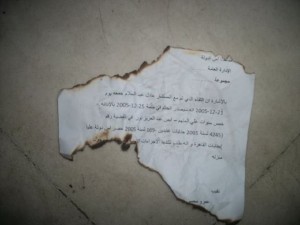
Document revealing the verdict of Ayman Nour's 2005 trial, four days before it was announced. By @kareem_elshaer.

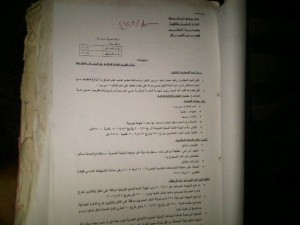
Document revealing State Security plan to get rid of documents.
By @AEIMassry.

Citizens sort through documents inside Amn Dawla in Nasr City.
By @PakinamAmer.

Document from the 'Copts' file in Amn Dawla.
By @PakinamAmer.


Piles of documents being guarded by the military.
By @WaelAbbas.

Document revealing 29,000 tons of imported wheat were known to have radiation.
By @Crinckle0.

Thursday, March 3, 2011

Who, exactly, is currently running Egypt?

The Supreme Council of the Armed Forces was charged with the administration of Egypt when former president Hosni Mubarak stepped down on February 11, 2011. So for right now, they're the ones running the country. But who are they, exactly? This great chart, put together by The Arabist, explains:

To view the full-size image, go here: http://www.arabist.net/storage/uploads/SCAF.pdf

Sunday, February 27, 2011

Will Egyptians forgive the army's mistakes?


Egyptians love and respect their armed forces. Ever since the Egyptian army reclaimed the Sinai Peninsula from Israel in 1973, the army has been held in high regard by the people.
When military tanks rolled into Cairo on the evening of January 28, they were greeted with cheers, kisses, and flowers. On that Friday, they were received as saviors from the brutality of Egypt’s hated Central Security Forces, who for four days had attempted to put down the Egyptian uprising by using force against unarmed demonstrators. Finally, the army had arrived.
As demonstrations continued in Tahrir Square, tanks were covered with men, women, and children waving the Egyptian flag. Army personnel were greeted with smiles across the city, and they remained true to their word: they did not use violence against the demonstrators.
The Supreme Council of the Armed Forces was charged with the country’s administration on February 11, when Hosni Mubarak resigned from the presidency after thirty years in power. For the most part, Egypt’s people approved. There was some resignation, but the military is one of the few institutions most Egyptians trust.
Around the time of Mubarak’s resignation, there were whispers that the army was detaining people and holding them in the Egyptian Museum, located on the edge of Tahrir Square. The news stirred some talk, but it soon died down.
Over the past few days, however, the army’s relationship with the people has been tested. On Friday night, military police surrounded demonstrators outside the Egyptian parliament in downtown Cairo and instructed journalists to leave. In Tahrir Square, the army took down tents and chased demonstrators from the square with sticks and tasers.
Egyptians were outraged.
The incidents took place well after midnight, around 2am. “Why are they surrounding us, civilians, with weapons?!” asked Gigi Ibrahim, a young activist who has become a recognized and semi-permanent face in Tahrir Square. “The army is the same as the Central Security, just in different clothes,” wrote angry Egyptians on Twitter. Comparing the highly respected army to the hated and feared security forces shows how deeply shaken Egyptians were by the army’s actions.
It was a severe blow to their faith in the armed forces.
The next morning, cafes were buzzing with the news, as were social networking sites such as Facebook and Twitter. Some argued that the army was trying to enforce the curfew – which should run from midnight to 6am, and which demonstrators have mostly ignored – but had gone about doing so the wrong way. Some said the army was unused to dealing with civilians, others said its actions were inexcusable.
On Saturday night, dozens of groups of friends sat in plastic chairs drinking tea or Turkish coffee around small tables at El Boursa, a group of cafes in the financial district in downtown Cairo. Many were discussing the recently announced constitutional amendments, but the discussion inevitably turned to the incident with the army.
“What happened last night is very bad,” commented an elderly artist who had been an activist in his youth. Behind his glasses, his eyes were troubled.
Haitham, a young activist and member of the al-Ghad liberal party, was also concerned. “How could this happen?” he asked.
Many were worried about the incident, fearing it might be the beginning of a new policy of action by the military but hoping it wasn’t. As worrying as the events of Friday night were, many Egyptians wanted to believe the army’s actions were a mistake, and that the army was still on their side. On Saturday afternoon, the army released a statement on its Facebook page apologizing for the incident and saying some people were trying to undermine to goals of the revolution.
Some Egyptians were willing enough to accept the statement, but others remained wary.
The army must be extremely careful in both its actions and its image during this critical time in Egypt, because the people’s faith in the army is just as vital as sincerity on the part of the army if the transition to democracy is to be achieved. If the people’s trust in the army is severely shaken, their trust in the process facilitated by the army will be as well.
Already another video has begun circulating on Facebook and YouTube, showing a group of men detained by the army in Port Said. One man, blindfolded with his hands tied behind his back, is prodded by a soldier with a stick-like taser. Should similar evidence continue to surface, the Supreme Council of the Armed Forces is going to have a major problem on its hands.
Egyptians seem willing to forgive the army once, but they may not do so twice.
** This post was originally published as an op-ed in Bikya Masr

Friday, February 18, 2011

"I am Egyptian"


Piles of t-shirts spill out of suitcases on the ground. Young men with fistfuls of flags weave through the crowds, looking for buyers. Small groups gather to have the Egyptian flag painted on their cheeks free of charge. Young children are everywhere – in their mother’s arms, on their father’s shoulders, happily waving the Egyptian flag.

A week after the historic announcement that Hosni Mubarak was stepping down as president of Egypt, Egyptians are still celebrating.

Now, members of the military smile and pose for pictures where before they would sternly shake their heads. If families were common in Tahrir before Mubarak’s resignation, now they are everywhere. Even foreigners who have made Cairo their home have started to gather in Tahrir with their families and young children.

Increasingly the feeling in Tahrir Square is like that of a festival. Gone is the underlying tension, the worry that more government thugs will attack the peaceful atmosphere in Cairo’s Liberation Square.
On the other hand, some Egyptians stood in the square looking a bit bewildered. “We’re here… what do we do now?” one commented twenty-something girl to her friend.

Others have echoed the thought: Mubarak has left… why are they still gathering? Some come to honor the memories of the martyrs, whose pictures hang from various points along the square. Others come to visit with friends, for an afternoon out, or simply to bask in the strange freedom of gathering freely in public with thousands of others.

Egyptians are well aware that their struggle is not over. Much work remains to be done if Egypt is to become a democratic state. Even so, they seem intent on enjoying this first victory before moving on to the next battle.

Monday, February 14, 2011

Remembering the past as the future unfolds

For days I have sat here staring at a blank screen with no idea what to write. How do I express what I've seen in the past few weeks? How do I express how I feel, what I think? I have been remiss in uploading and publishing comments, news, anything.

Yesterday I stumbled upon Jehan Sadat's autobiography. Jehan was the wife of Anwar Sadat, the man who made peace with Israel and whose death left Hosni Mubarak in control of the country for the next thirty years. Somehow, the timing seems appropriate.

So far I've only read the first two chapters, where Jehan describes her husbands death, and then goes back to the beginning - growing up in Cairo. Some of the wonders she describes I've seen and wondered at myself: the oldest mosques, Coptic Cairo, Khan el-Khalili, the mix of modern and ancient, European and Egyptian.

Some of her memories are long gone, such as the Nile's annual flood, or watching the British move through the streets in their horse-drawn carriages.

But again, somehow the timing seems perfect. Now, as I prepare to go back to the beginning of what will be a new Egypt, I am remembering the sort of breathless awe with which I anticipated my first views of the city two and a half years ago. Part of me wishes I hadn't left in the middle of the Revolution, even though foreigners and journalists were being targeted. At the same time, I've always argued that one of the best parts about saying goodbye is that you get to say hello again. When I return to Cairo I will not only be saying hello again, to the city and to friends who have become like family, but I will be returning home to the beginnings of a new city.

Saturday, February 12, 2011

Egypt’s Revolution: A victory embodied by the Egyptian spirit

No one expected that peaceful protests and perseverance could topple the third-longest ruler in Egyptian history – but they did, and in less than three weeks.

What’s more, Egyptians won their victory as a people, not as a mass following a leader. Throughout history there have been various peaceful revolutions, but each had a figurehead: Nelson Mandela in South Africa, Gahndi in India, Martin Luther King in the Civil Rights movement in the United States. Each a worthy cause with a worthy leader.

Many images from the last nineteen days will be recorded in history: Egyptians chanting ‘peaceful, peaceful’ before being attacked by State Security; armored trucks turning water cannons on demonstrators as they prayed; Christian Egyptians surrounding their Muslim brothers, protecting them as they prayed; millions of people gathered in Tahrir – Liberation – Square.

These are the images of a people long known as friendly and hospitable, who have shown the world how deeply the Egyptian spirit runs.

In the early days of the revolution, for every young man who wanted to throw a stone at State Security forces there were five others to stop him. They would not instigate violence, but at a point demonstrators did retaliate: Police shot tear gas at demonstrators. The people kicked it away, threw it back, or tried to put it out. Police threw stones. Demonstrators threw them back. Police shot rubber bullets at demonstrators. Demonstrators set police vans on fire.

Even so, the overwhelming desire among the people was for everything to be peaceful. When State Security withdrew from Cairo on January 28, the people did not chase them out. On the contrary, I witnessed some demonstrators go to them and congratulate them, sharing the victory.

In less than three weeks Egyptians shattered the wall of fear which had kept them silent for decades. The wall had been cracked already, and the foundation was a bit unstable, but until January 25 that wall still stood. On the evening of January 25 I stood in Tahrir Square as tens of thousands of Egyptians gathered there for the first time, giddy with excitement.

I spoke with a lawyer who had helped found the human rights movement in Egypt in the 1970s, and had been part of the student demonstrations in 1973 and 1977. “I was here in Tahrir in 1977 and I was arrested for that demonstration,” he told me. “And now I am here again and I see all these young people, the age of my son and my daughters.” For him, as for many others, it was an emotional moment.

Destroying that ‘culture of fear,’ as I once heard it called, is one of the single most important victories of Egypt’s revolution. Whatever happens next, Egyptians now know that they can go to the streets and demand their rights.

So, what happens next? This is the question both Egyptians and the world have been asking for nineteen days. Hosni Mubarak, against all odds, is gone. What now?

Many have expressed the fear of a power vacuum. The military is in control, but that makes some uneasy. Others fear the Muslim Brotherhood will take over and impose some version of Islamic rule. Some of the fears are valid, some misplaced, but all seem to have overlooked the most important thing Egyptians have taught themselves and the world over the past nineteen days: Egyptians can take care of themselvevs.

Egyptians can take care of themselves. When the police pulled out of the city, Egyptians took it upon themselves to safeguard their homes and their history. They locked arms in front of the Egyptian Museum to protect it, and when thugs broke in from the roof the people quickly arrested them and turned them over to the army.

Within hours of the disappearance of security guards and traffic police, citizens organized road blocks, checkpoints, and neighborhood watch groups – and all without access to the internet or mobile phones.

Committees were organized to clean the streets and pick up garbage. People took it upon themselves to set up makeshift clinics in Tahrir Square and to bring food, water, and blankets to distribute to the people demonstrating there 24 hours a day.

Egypt did not fall into chaos, and did not fall for the rumors the government was trying to spread. In places where there was violence and looting, the people knew it was government-hired thugs and prisoners who mysteriously escaped from prisons who were causing trouble: it was not the people themselves.

The regime tried to force the people to choose between security and liberty and the people, in true Egyptian fashion, made their own option. They chose both. And it will not be quick or easy, but with more of the perseverance and compassion Egyptians have embodied in the last three weeks, they will keep both.

Thursday, February 10, 2011

#ReasonsMubarakIsLate

As Egyptians and the world waited for Mubarak to make his third (and many hoped final) speech on Thursday night, it didn't take long for hashtag '#ReasonsMubarakIsLate' to trend worldwide on Twitter. Egyptian humor cannot be beaten!

Here are a few of my favorites: