Showing posts with label cairo. Show all posts

Monday, August 20, 2012

Here's where I stand on the Eid harassment photos

Women were harassed during the Eid al-Fitr holiday in Cairo. It's abhorrent and should be stopped. I fully support that. I also fully support spreading harassers' pictures across the globe and calling their mothers AND aunties.

However, it DISGUSTS me that whoever caught these images on camera - of women being harassed, boys grabbing women's behinds, etc - did not bother to blur the victims' faces before spreading the images across the internet. Did it not occur to you that these poor girls' privacy has already been invaded enough? Would you post a picture of your little sister - who looks barely 14 - having BOTH of her breasts grabbed by two different boys behind her? Would you want that picture to go viral? No? Well I've seen that picture floating around tonight.

The argument that it takes too long to blur the faces and it's better to just get the pictures out there is COMPLETELY inexcusable, in my opinion. As a photographer, especially if you're trying to call yourself a photojournalist or a journalist, it is your RESPONSIBILITY to act ethically, and that includes protecting your sources and protecting victims, ESPECIALLY if they're underage. Take the 10 seconds (or 5 minutes) to either blur or black out the victims' faces and/or eyes. Is your five minutes really worth potentially prolonging a young girl's horrifying experience?

I've heard the argument that these images and information should be shared at all costs. I understand the argument, I understand the argument that seeing the shock, horror, violation on the victim's face makes the image more powerful.

But ethically, it's still wrong. Imagine being that 14-year-old girl. Now imagine if one of your classmates (or cousins) stumbles upon that picture. You already know how prevalent sexual harassment is in Egyptian society AND how often women are blamed for it. Do you think her classmates will support her? Or will they snigger behind her back? Now: do you really think spreading that girl's face was worth it?

I understand that there is a fine line there, especially when people are whole-heartedly, and with good intentions, trying to support something so essential as ending sexual harassment. But unless the victim has given permission, it is just further violation of their privacy.

Some people will disagree with me, either for the reasons above or for other reasons. I get that. It's your right.

But please, have some respect.

Edit: If these girls want to tell their stories, more power to them - but the choice should be theirs. It shouldn't be made without their knowledge or consent.

Video: 'Fix You' - HanyMust & Hana Malhas live at Sakia


Cover of Coldplay's 'Fix You' by Cairo's own Hany Mustafa, joined on stage by Jordanian singer Hana Malhas at El-Sawy Culture Wheel. August 10, 2012.

Video by Sallie Pisch Photography. All rights reserved.

HanyMust: http://facebook.com/HanyMust
Hana Malhas: http://facebook.com/hanamalhas

Tuesday, June 26, 2012

What's the use of one more blog post?


Over the years this blog has become less personal and more of an outlet for current events in Egypt or socio-political commentary, sometimes based on personal experience.

This post will be very personal.
___________________________________________________________________

The tweet read, “All I could see was leering faces . . sneering & jeering as I was tossed around like fresh meat among starving lions”.

Another woman attacked in Tahrir Square. I knew without opening the attached link. I opened it anyway. I didn’t want to read the story; I had to.

The most detailed first-person account of a sexual attack in Tahrir I’ve ever read. That’s what was in the link. I was sitting in a noisy café listening to – of all things – a song called “Past the Point of No Return.” I turned it off, and I read.

I was stripped naked… Hundreds of men… forcing their fingers inside me in every possible way… A small minority of men… tried to protect me… I felt surprisingly calm… Please God. Please make it stop… Women surrounded me and tried to cover my naked body… The men outside… wanted my blood… I was barefoot, dodging broken glass… We eventually… reached a government hospital… we were turned away… “Are you married? A virgin?”… I was refused examination and treatment.

An hour later I can’t get her words out of my head.

What if it had been me?

I was physically harassed once during the 30 months I’ve spent in Cairo. In comparison it was nothing. Yet a year and a half later I refuse to go anywhere in Maadi by myself because the memory makes me ill and nervous (Maadi has the highest concentration of Western foreigners of any neighborhood in Cairo).

It unnerved me enough that this is only the third time I’ve ever mentioned the incident.

I may not be blonde, but I’m young and pretty with fair skin and light eyes. I speak enough Arabic to talk to a cab driver but no more. Sure, I’m good at reading crowds. I’ve been going to Egyptian demonstrations longer than most Egyptians. Yes, I’ve actually taken a class on risk management.

But the crowd can change in a moment.

I’m not infallible. Gut instinct is not infallible. What if, wanting that one last photo, I stayed just a minute too long? What if the situation changed too quickly for me to get away? What if I got caught up in a conversation and didn’t notice the crowd shift?

What if, what if, what if.

They’re useless but I can’t get them out of my head. I keep picturing myself – graphically – in this woman’s position. I picture my reflection in the mirror. It’s terrifying.

 I love Egypt. I wouldn’t be here if I didn’t. There are things I hate but I’m still here and I don’t want to leave. At the same time, I came to Egypt as a journalist and I haven’t gone to Tahrir Square in weeks.

I tell myself I’m being lazy, that I should go down and take some pictures and judge the feel of the crowd for myself. After all, I was in Tahrir Square on the 25th and the 28th of January. I was by Maspiro the night dozens were killed in clashes between Coptic Christian demonstrators and the military. I was in Mohamed Mahmoud Street choking on tear gas alongside Egyptian men and women last November.

But as more and more women report graphic sexual assaults in Tahrir I’m terrified I’ll be next. I loathe that fear almost more than I loathe the fact that the fear is warranted.

I remember going to Tahrir and not being touched by a single man, except honest-to-goodness accidents. The last few weeks, I don’t know a single female who has gone to Tahrir without being groped at least once.

So what do I do? Stay safely in Zamalek and talk politics with my friends? Offer opinions on the “current situation” without actually going out in the streets, something I love? Pack up and move somewhere I can wear skirts and sleeveless shirts without a leering man with a disgusting comment on every single street corner?

Scratch that option. Recent statistics show at least 1 in 6 college-age men in America will admit to raping a woman in anonymous surveys, so long as the word ‘rape’ is left out of the definition (“rape” is defined by the insertion of any object into any orifice of the body without consent).

Anyone who knows me knows if there’s one thing I’m not, it’s helpless. Yet against this I am utterly and completely helpless. It’s frustrating and infuriating and I feel I’m losing a battle I have no idea how to fight.

I almost didn’t post this. I thought, what’s the use of one more blog post? But we cannot doubt the power of our own voices. Eventually it will be that one pissed off woman outing her harasser in the street, that one man jumping between a woman and her attacker, maybe even that one angry blog post that tips the balance.

If we – men and women – stay silent, we will lose. So be loud. Be insistent. Make a scene and refuse to be silenced and we will win.

Sunday, January 29, 2012

Egypt's Day of Rage as I saw it - Video


Video compilation of clips from Friday, January 28, 2011 in Cairo's Abdel Moneim Reyad Square, just steps from the now-iconic Tahrir Square.

Monday, January 23, 2012

Wednesday, November 23, 2011

Questions over type of gas used against Egypt demonstrators remain unanswered


Every Egyptian who was in the streets during Egypt’s January uprising, it seems, insists the gas used against demonstrators over the past five days is much stronger than what was used in January.

There are rumors that Egyptian Central Security Forces are not using CS gas, known as ‘tear gas’ and commonly used to disperse demonstrations, but the more debilitating CR gas. One difference in the substances is that while water dilutes CS gas, it exacerbates the effects of CR gas.

Some have claimed that there are nerve agents in the gases used against demonstrators in Mohamed Mahmoud Street, which connects Cairo’s iconic Tahrir Square to the Ministry of Interior in downtown Cairo.

Even Mohamed el-Baradei, a popular presidential hopeful and former director of the UN’s nuclear watchdog agency, has suggested that the gas used by riot police against demonstrators isn’t just tear gas.

“Tear gas with nerve agents and live ammunition are being used against civilians,” Baradei said on his official Twitter account on Tuesday. “A massacre is taking place.”

According to Ministry of Health figures, at least 35 people have been killed since clashes broke out between demonstrators and CSF on Saturday morning. Thousands have been injured.

Medics on the scene say the symptoms they have seen over the past five days are completely different from those they saw during demonstrations in January.

One medic told me today that the chest pain, convulsions and seizures caused by the gas during the past weel were not seen at all in January.

Many consider this proof that a different gas is being used.

However, there is another factor: the vast majority of the gas used in January was expired. Most canisters listed a manufacture date of 1999 with a five-year shelf life. The majority of the canisters seen over the past five days - either personally or in photos - were manufactured in August 2010 and consequently are not expired.

“It’s possible,” one medic told me when asked if the new symptoms could simply be from non-expired tear gas. “We won’t know until it’s tested in the lab.”

Two medics today told me that Human Rights Watch and other international NGOs have taken samples of the gases and canisters to determine what they are.

Many gas canisters are marked ‘RIOT CS SMOKE,’ but many more bear no markings whatsoever.

Another medic said samples analyzed in the pharmacy revealed minute traces of cyanide, an extremely deadly poison.

No other sources have confirmed or denied this, and me was not given access to the report.

The Egyptian Ministry of Health says it is also analyzing samples and will reveal the full results without holding anything back.

Some, however, are skeptical.

“We can’t trust what the Ministry of Health says,” one medic in Tahrir Square told me. “They won’t tell us the truth.”

The names of the medics who spoke to me have been withheld for their safety.

This post was initially published at Youm7 English Edition (offline since Jan 2012).

Monday, November 21, 2011

Tear-gassed childhood


A child should never have to know what tear gas is, much less experience it.

Video: Mohamed Mahmoud clashes

Short video of the first of now three days of clashes between Egyptian protesters and riot police on the streets of downtown Cairo.

Monday, October 10, 2011

"The military has thugs," he told me

The hoarse cry came from a man dashing across Cairo’s Abdel Moneim Reyad Square on Sunday night. “The military has thugs! The military has thugs!”

He paused long enough to reiterate the statement to myself and another female journo moving in the opposite direction – “The military has thugs!” – before continuing toward nearby Tahrir Square, the epicenter of Egypt’s January 25 Revolution.

Behind him, a group of military police became clearly visible as they rounded a corner. Among the uniforms were people in plainclothes carrying large sticks and clubs.

The clubs started to swing, and those still in the square ran for cover.

It was around 8pm. The clashes began hours earlier. “This feels like the 28th of January,” someone said, referencing Egypt's 'Day of Rage,' one of the most violent days of the uprising that toppled Egypt’s former regime earlier this year.

The cat-and-mouse game between military police and demonstrators continued into the night as wild rumors spread.

Near the Egyptian Museum, a group of four young people glanced between their cell phones and the scene around them, probably updating Twitter on the situation and their safety.

Twitter is a primary means for activists to keep tabs on each other during demonstrations in Egypt.

Earlier in the evening, the area by the Ramsis Hilton where the military police entered Abdel Moneim Reyad Square was occupied by demonstrators. This was where they carried the wounded from Maspiro, the nearby site of ongoing clashes between Coptic Christian demonstrators, military police and unknown plainclothes persons.

The clashes left at least 26 dead, according to the most recent figures from the Ministry of Health.

Some activists put the number much higher.

Clashes began when unknown persons attacked a Coptic Christian demonstration. When military police  finally intervened it was not to protect the demonstrators, according to eyewitnesses.

Christian demonstrators seeking refuge by the Hilton from the violence and tear gas told me, “The army is killing Christians.”

As the situation around the Hilton intensified, young men directed traffic away from the area. An armed personnel carrier and other vehicles burned, sending a dense black smoke into the air above the Nile.

A fire truck arrived, presumably to put out the fires. It was greeted with stones and rocks, but eventually allowed to pass.

Outside the Hilton, cries of the injured permeated sporadic chants of, “The people want the fall of the musheer,” Egypt’s military ruler, and “Where are our rights?”

One man’s screams faded into dull moans as he was placed on the ground after being carried from Maspiro on a blanket. A group of young men kept the crowd back to give the injured man air, only allowing me, as a photographer, near him, so I could document “what the army did to the Christians.”

A sudden stir in the crowd announced the arrival of Bothaina Kamel, the only woman to announce her candidacy for the Egyptian presidency so far. Wearing a bright orange reflective vest, Bothaina moved quickly through the crowd toward the Nile, the latest location of clashes between military police and demonstrators.

Many Muslims quickly joined their Christian brothers after clashes began. A Coptic man named Nabil told me that Muslims had saved his life twice that night.

Outside the Hilton, one Copt held a string of Muslim prayer beads along with his cross. “Both Muslim and Christian are here,” said another.

“Heard a Muslim guy urging other protesters, ‘let’s head to the front, I’m not gonna let the Christians take a bullet alone,’” tweeted activist Mosa’ab Elshamy. Such poignant moments are reminiscent of the early days of the Egyptian revolution, when Coptic Christians joined hands to protect their Muslim countrymen as they prayed in the streets.

Many Christians were angry, saying they felt they were being targeted. Coptic Christians comprise around 10 percent of Egypt’s population, and often say they are not treated equally to the Muslim majority.

“Christians will live in Egypt forever,” said one Coptic man, angrily blaming the extremist Islamic Salafi trend for being behind attacks against Christians. “They will not make us leave.”

While one man asked repeatedly, “Where is the United Nations?,” another insisted, “We are not asking for international protection.”

A number of activists reported a very different show of solidarity: “I cannot believe it the battle is over and the people who were hitting us from the other side have joined us,” tweeted Lilian Wagdy, an activist on the ground.

A few hours later, popular ‘tweep’ Mahmoud Salem, known on Twitter as ‘Sandmonkey,’ relayed a similar situation. He reported clashes between groups of Egyptians, all in plainclothes, with one side chanting, “The people and the army are one hand” and the other side “Muslims and Christians are one hand.”

Then, he tweeted, “In a very weird moment, both sides started chanting ‘one hand,’ stopped fighting, joined each other into one big marsh.”

At some point, the rumors started to fly, by word of mouth, on Twitter, and in the media.

Among the quickest to spread were claims that U.S. Secretary of State Hilary Clinton had announced that the U.S. would send troops to Egypt to protect Christian churches.

While the United States and the U.S. Embassy in Cairo emphatically denied the rumor, it still made the front page of some Egyptian newspapers on Monday morning.

Another rumor that has proven impossible to confirm claimed someone – either thugs or military personnel – threw dead bodies into the Nile. I have been unable to locate an eyewitness to this incident.

“I say again, I saw three military police throw dead bodies in the Nile, and another body was under their feet,” wrote Mohamed Elmoshir on Twitter.

Some rumors were true: shortly before midnight, I witnessed a military soldier shoot live ammunition in Tahrir Square, and videos of military vehicles driving at reckless speeds through crowds of demonstrators quickly appeared on YouTube.

As Monday dawned, Egyptians were angry, scared, saddened, and, perhaps most of all, worried. What would happen next? What did clashes between the army and the people mean for the transitional period? Blame for last night’s events has been placed on everyone from the demonstrators to Salafis to elements of Egypt’s formerly ruling regime to the military to the ubiquitous “foreign hand.”

One image, provided to the AUC Caravan, perhaps best illustrates the divisions and solidarity on both sides of the battle. In it, a uniformed military soldier carries an injured boy down a debris-strewn street. Another boy and a man in civilian clothes follow the soldier.

In the background, military soldiers and civilians stand, motionless.

**A version of this post was originally published at Youm7 English Edition (offline since Jan 2012).

Tuesday, June 7, 2011

Remembering Khaled Said

Some would argue his death started a revolution – or at the very least was one of its major catalysts. Khaled Said is still burned into Egypt's memory a year after his brutal death.

Today Egyptians gathered in Cairo, Alexandria and Fayoum to remember Khaled.

While the exact details continue to be disputed, Khaled was killed at the hands of Egyptian police in Alexandria on June 6, 2010. He was beaten to death and his body was dumped his home. Four days later his story spread rapidly across the internet after prominent opposition politician Ayman Nour publicized Khaled’s death and pictures of his mangled face.

Egyptians were outraged. Protests were organized. In Khaled’s home city of Alexandria, men and women stood along the corniche, the road separating the city from the Mediterranean Sea, every Friday afternoon. They dressed in black. They carried the Bible or the Quran, and they prayed silently for Khaled’s soul.

Stark images of educated, upper-middle-class youth stretching down the corniche drew more attention. These were not the small, violent demonstrations Egyptians were accustomed to. Those attending actually had something to lose.

Yet Khaled was not the first to die at the hands of Egyptian police. There were many before him. So why did Khaled Said, a 28-year-old businessman, draw millions of supporters to a Facebook page within days? Why were weekly demonstrations organized in Alexandria and Egypt’s capital, Cairo, for months after his death?

Ultimately, the answer is simple: Egypt’s politically inactive middle class considered him one of their own.

Shortly after news of Khaled’s murder was made public, an Egyptian friend told me why he – an upperclass Egyptian who wasn’t involved in politics and had the money for a good education – was so affected by Khaled’s death: “He didn't look for trouble, yet corruption killed him anyway. Maybe they've done worse things before, but this directly threatens me: this is a young guy who comes from almost the same background as me and most of my friends. He does the same things that I do. He stays out of trouble. And yet, this.”

My friend, like many other Egyptians, believed he could be next.

While some of those who publicized Khaled’s case were seasoned activists, many more were not. For the first time, portions of Egypt’s middle class went to the streets in public demonstrations – perhaps the most politically repercussive aspect of Khaled’s death.

In the earliest days of Egypt’s January 25 Revolution, the people taking to the streets were not underpaid laborers or career activists. They were Egypt’s educated middle class, and the first time they had gone to the streets was after Khaled’s death. There were chants for better wages and economic issues, but the calls for democracy, freedom, and human rights were louder. It was, in the beginning, not a bread uprising but a call for what many have termed the “Western” ideals of personal freedom.

The career activists and the politicians were there as well, but they were outnumbered by ordinary Egyptians. Soon the economic demands came. A wave of labor strikes has hit Egypt in the wake of the revolution. Now, people believe they have the right to make their demands heard.

Khaled’s death did not cause the Egyptian revolution. According to a recent poll by the International Republic Institute his death was not even a major motivating factor for Egyptians to participate in or support the revolution.

Khaled’s death was important in a different way. It catalyzed a realization among Egypt’s middle class, who could afford their basic needs: they were no longer safe simply by staying out of politics. For the first time, many decided long-term benefits of going to the streets outweighed the short-term risks.

Now, a year after his death, Egyptians remember Khaled. He is remembered not only as a martyr of the former regime, but as a symbol for everything Egyptians have lost and everything they stand to gain: the rights to life and liberty.

Wednesday, March 9, 2011

Photo of the Week: Coptic boy at Cairo demonstration


A Coptic boy has an Egyptian flag, a cross, and a crescent painted on his face during a demonstration of Coptic Christians in Cairo on March 9, 2011.

Friday, February 18, 2011

"I am Egyptian"


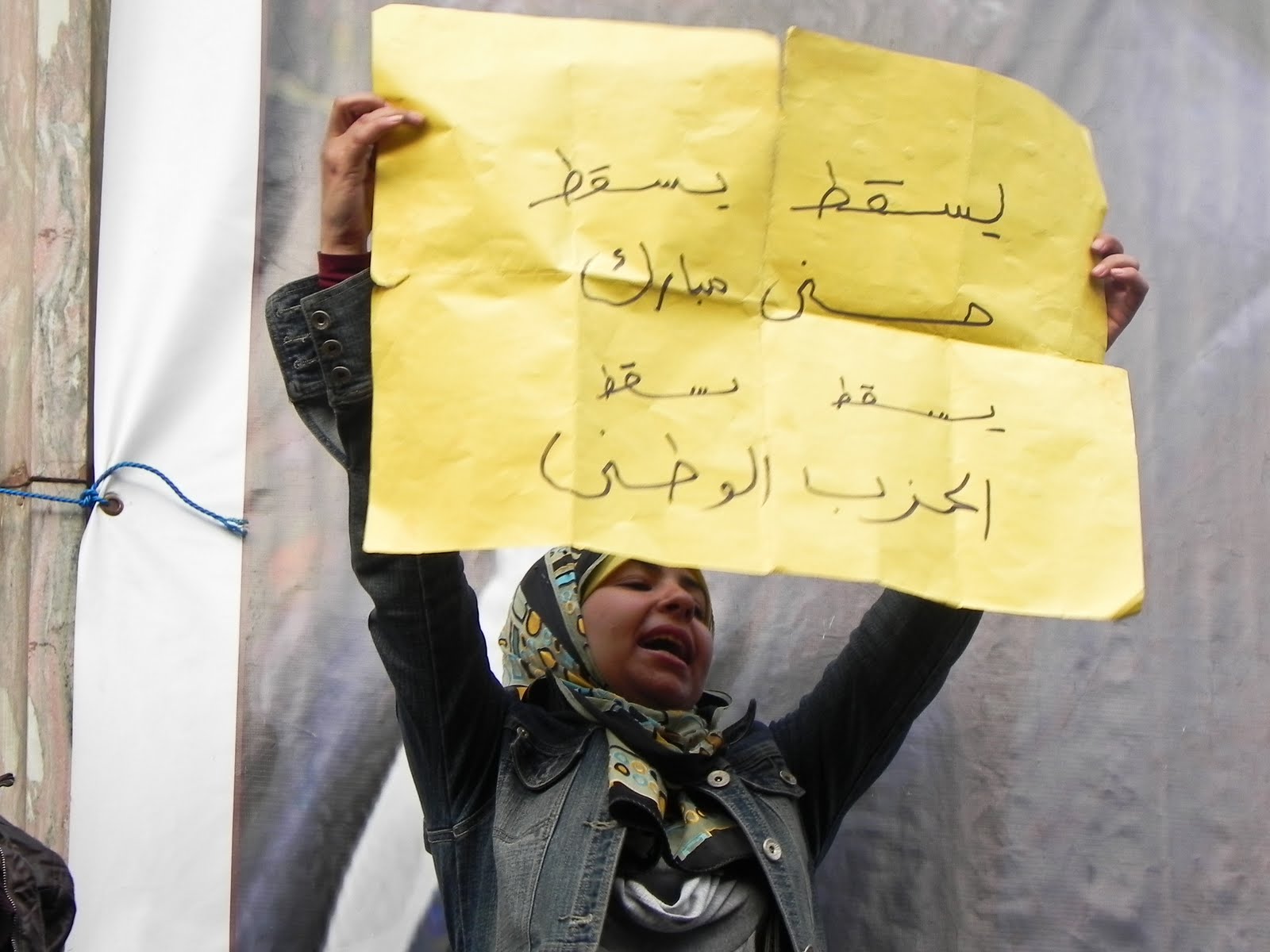
Piles of t-shirts spill out of suitcases on the ground. Young men with fistfuls of flags weave through the crowds, looking for buyers. Small groups gather to have the Egyptian flag painted on their cheeks free of charge. Young children are everywhere – in their mother’s arms, on their father’s shoulders, happily waving the Egyptian flag.

A week after the historic announcement that Hosni Mubarak was stepping down as president of Egypt, Egyptians are still celebrating.

Now, members of the military smile and pose for pictures where before they would sternly shake their heads. If families were common in Tahrir before Mubarak’s resignation, now they are everywhere. Even foreigners who have made Cairo their home have started to gather in Tahrir with their families and young children.

Increasingly the feeling in Tahrir Square is like that of a festival. Gone is the underlying tension, the worry that more government thugs will attack the peaceful atmosphere in Cairo’s Liberation Square.
On the other hand, some Egyptians stood in the square looking a bit bewildered. “We’re here… what do we do now?” one commented twenty-something girl to her friend.

Others have echoed the thought: Mubarak has left… why are they still gathering? Some come to honor the memories of the martyrs, whose pictures hang from various points along the square. Others come to visit with friends, for an afternoon out, or simply to bask in the strange freedom of gathering freely in public with thousands of others.

Egyptians are well aware that their struggle is not over. Much work remains to be done if Egypt is to become a democratic state. Even so, they seem intent on enjoying this first victory before moving on to the next battle.

Monday, February 14, 2011

Remembering the past as the future unfolds

For days I have sat here staring at a blank screen with no idea what to write. How do I express what I've seen in the past few weeks? How do I express how I feel, what I think? I have been remiss in uploading and publishing comments, news, anything.

Yesterday I stumbled upon Jehan Sadat's autobiography. Jehan was the wife of Anwar Sadat, the man who made peace with Israel and whose death left Hosni Mubarak in control of the country for the next thirty years. Somehow, the timing seems appropriate.

So far I've only read the first two chapters, where Jehan describes her husbands death, and then goes back to the beginning - growing up in Cairo. Some of the wonders she describes I've seen and wondered at myself: the oldest mosques, Coptic Cairo, Khan el-Khalili, the mix of modern and ancient, European and Egyptian.

Some of her memories are long gone, such as the Nile's annual flood, or watching the British move through the streets in their horse-drawn carriages.

But again, somehow the timing seems perfect. Now, as I prepare to go back to the beginning of what will be a new Egypt, I am remembering the sort of breathless awe with which I anticipated my first views of the city two and a half years ago. Part of me wishes I hadn't left in the middle of the Revolution, even though foreigners and journalists were being targeted. At the same time, I've always argued that one of the best parts about saying goodbye is that you get to say hello again. When I return to Cairo I will not only be saying hello again, to the city and to friends who have become like family, but I will be returning home to the beginnings of a new city.

Saturday, February 12, 2011

Egypt’s Revolution: A victory embodied by the Egyptian spirit

No one expected that peaceful protests and perseverance could topple the third-longest ruler in Egyptian history – but they did, and in less than three weeks.

What’s more, Egyptians won their victory as a people, not as a mass following a leader. Throughout history there have been various peaceful revolutions, but each had a figurehead: Nelson Mandela in South Africa, Gahndi in India, Martin Luther King in the Civil Rights movement in the United States. Each a worthy cause with a worthy leader.

Many images from the last nineteen days will be recorded in history: Egyptians chanting ‘peaceful, peaceful’ before being attacked by State Security; armored trucks turning water cannons on demonstrators as they prayed; Christian Egyptians surrounding their Muslim brothers, protecting them as they prayed; millions of people gathered in Tahrir – Liberation – Square.

These are the images of a people long known as friendly and hospitable, who have shown the world how deeply the Egyptian spirit runs.

In the early days of the revolution, for every young man who wanted to throw a stone at State Security forces there were five others to stop him. They would not instigate violence, but at a point demonstrators did retaliate: Police shot tear gas at demonstrators. The people kicked it away, threw it back, or tried to put it out. Police threw stones. Demonstrators threw them back. Police shot rubber bullets at demonstrators. Demonstrators set police vans on fire.

Even so, the overwhelming desire among the people was for everything to be peaceful. When State Security withdrew from Cairo on January 28, the people did not chase them out. On the contrary, I witnessed some demonstrators go to them and congratulate them, sharing the victory.

In less than three weeks Egyptians shattered the wall of fear which had kept them silent for decades. The wall had been cracked already, and the foundation was a bit unstable, but until January 25 that wall still stood. On the evening of January 25 I stood in Tahrir Square as tens of thousands of Egyptians gathered there for the first time, giddy with excitement.

I spoke with a lawyer who had helped found the human rights movement in Egypt in the 1970s, and had been part of the student demonstrations in 1973 and 1977. “I was here in Tahrir in 1977 and I was arrested for that demonstration,” he told me. “And now I am here again and I see all these young people, the age of my son and my daughters.” For him, as for many others, it was an emotional moment.

Destroying that ‘culture of fear,’ as I once heard it called, is one of the single most important victories of Egypt’s revolution. Whatever happens next, Egyptians now know that they can go to the streets and demand their rights.

So, what happens next? This is the question both Egyptians and the world have been asking for nineteen days. Hosni Mubarak, against all odds, is gone. What now?

Many have expressed the fear of a power vacuum. The military is in control, but that makes some uneasy. Others fear the Muslim Brotherhood will take over and impose some version of Islamic rule. Some of the fears are valid, some misplaced, but all seem to have overlooked the most important thing Egyptians have taught themselves and the world over the past nineteen days: Egyptians can take care of themselvevs.

Egyptians can take care of themselves. When the police pulled out of the city, Egyptians took it upon themselves to safeguard their homes and their history. They locked arms in front of the Egyptian Museum to protect it, and when thugs broke in from the roof the people quickly arrested them and turned them over to the army.

Within hours of the disappearance of security guards and traffic police, citizens organized road blocks, checkpoints, and neighborhood watch groups – and all without access to the internet or mobile phones.

Committees were organized to clean the streets and pick up garbage. People took it upon themselves to set up makeshift clinics in Tahrir Square and to bring food, water, and blankets to distribute to the people demonstrating there 24 hours a day.

Egypt did not fall into chaos, and did not fall for the rumors the government was trying to spread. In places where there was violence and looting, the people knew it was government-hired thugs and prisoners who mysteriously escaped from prisons who were causing trouble: it was not the people themselves.

The regime tried to force the people to choose between security and liberty and the people, in true Egyptian fashion, made their own option. They chose both. And it will not be quick or easy, but with more of the perseverance and compassion Egyptians have embodied in the last three weeks, they will keep both.

Monday, February 7, 2011

Statement from Tahrir Square to the Egyptian people

A Statement from the protesters at Cairo's Tahrir square

to the Egyptian people

The President's promises and the bloody events of Wednesday February 2

We the protesters who are currently on sit-in at Tahrir (liberation) square in Cairo since January 25, 2011 strongly condemn the brutal attack carried out by the governing National Democratic Party's (NDP) mercenaries at our location on Wednesday February 2, under the guise of "rally" in support of President Mubarak. This attack continues on Thursday February 3. We regret that some young people have joined these thugs and criminals, whom the NDP is accustomed to hire during elections, to march them off after spreading several falsehoods circulated by the regime media about us and our goals. These goals that aim at changing the political system to a one that guarantees freedom, dignity and social justice to all citizens are also the goals of the youth. Therefore we want to clarify the following.

Firstly, we are a group of Muslim and Christian Egyptians; the overwhelming majority of us does not belong to political parties and have no previous political activism. Our movement involves elderly and children, peasants, workers, professionals, students and pensioners. Our movement cannot be classified as "paid for" or "directed by" a limited few because it attracted millions who responded to its emblem of removing the regime. People joined us last Tuesday in Cairo and other governorates in a scene that witnessed no one case of violence, property assault or harassment to anyone.

Secondly, our movement is accused of being funded from abroad, supported by the United States, as being instigated by Hamas, as under the leadership of the president of the National Assembly for change (Mohamed El-Baradie) and last but not least, as directed by the Muslim Brotherhood. Many accusations like these prove to be false. Protesters are all Egyptians who have clear and specific national objectives. Protesters have no weapons or foreign equipment as claimed by instigators. The broad positive response by the people to our movement's goals reveals that these are the goals of the Egyptian masses in general, not any internal or external faction or entity.

Thirdly, the regime and its paid media falsely blame us, demonstrators, for the tension and instability in the streets of Egypt in recent days and therefore for damaging our nation's interests and security. Our answer to them is: It is not the peaceful protesters who released the criminal offenders from prison to the unguarded streets to practice looting and plundering. It is not the peaceful protesters who have imposed a curfew starting at 3 o'clock PM. It is not the peaceful protesters who have stopped the work in banks, bakeries and gas stations. When protesters organized its one-million demonstration it came up in the most magnificent and organized form and ended peacefully. It is not the protestors who killed 300 people some with live ammunition, and wounding more than 2,000 people in the last few days.

Fourthly, President Mubarak came out on Tuesday to announce that he will not be nominated in the upcoming presidential election and that he will modify two articles in the Constitution, and engage in dialogue with the opposition. However the State media has attacked us when we refused his "concession" and decided to go on with our movement. Our demand that Mubark steps down immediately is not a personal matter, but we have clear reasons for it which include:

  • His promise of not to run again is not new. He has promised when he came to power in 1981 that he will not run for more than two periods but he continued for more than 30 years.
  • His speech did not put any collateral for not nominating his son "Gamal", who remains until the moment a member of the ruling party, and can stand for election that will not be under judicial supervision since he ignored any referring to the amendment of article 88 of the Constitution.
  • He also considered our movement a "plot directed by a force" that works against the interests of the nation as if responding to the demands of the public is a "shame" or "humiliation".
  • As regards to his promise of conducting a dialogue with the opposition, we know how many times over the past years the regime claimed this and ended up with enforcing the narrow interests of the Mubarak State and the few people who control it.

And the events of Wednesday proved our stand is vindicated. While the President was giving his promises, the leaders of his regime were organizing (along with paid thugs and wanted criminals equipped with swords, knives and Molotov bombs) a brutal attack plot against us in Tahrir square. Those thugs and criminals were accompanied by the NDP members who fired machine guns on unarmed protesters who were trapped on the square ground, killing at least 7 and wounding hundreds of us critically. This was done in order to end our peaceful national popular movement and preserve the status quo.

Our movement is Egyptian - Our movement is legitimate- Our movement is continuing

The youth of Tahrir Square sit-in

February 3, 2011 at 11:30am

بيان للشعب من معتصمين بالتحرير - الرجاء النشر والتوزيع

بيان للشعب

أول القصيد: وعود الرئيس وأحداث الأربعاء 2 فبراير

نحن محتجون منذ 25 يناير الماضي، ومعتصمون في ميدان التحرير، ندين بشدة الاعتداء الغاشم الذي نفذته مرتزقة الحزب الوطني علينا في مقر اعتصامنا يوم الأربعاء 2 فبراير تحت غطاء المظاهرة المؤيدة للرئيس لمبارك ويستمر العدوان يوم الخميس 3 فبراير. ونأسف لدخول البعض من شباب مصر مع البلطجية والمجرمين ممن اعتاد الوطني تأجيرهم في الانتخابات، وساقوهم علينا بعد أن أشاعوا اكاذيب عديدة يروجها النظام وإعلامه بخصوصنا وبخصوص اهدافنا المنادية بتغيير للنظام السياسي يكفل لنا ولجموع المواطنين الحرية وكرامة العيش والعدالة الاجتماعية، والتي هي ايضا من اهداف هذا الشباب، ولذلك نريد توضيح الاتي:

أولا، نحن مجموعة من شباب مصر مسلمين ومسيحيين، أغلبيتنا الكاسحة لا تنتمي لأحزاب سياسية ولا لها نشاط سياسي من قبل. حركتنا ضمت شيوخا وأطفالا، فلاحين وعمال ومهنيين، طلبة وموظفين على المعاش. حركتنا لا يمكن تصنيفها على أنها مدفوعة أو محركة من قلة بحكم الملايين الذين استجابوا لشعاراتها باسقاط النظام، وانضموا اليها يوم الثلاثاء الماضي في القاهرة والمحافظات، في حدث لم يشهد حالة عنف واحدة أو اعتداء على الممتلكات أو تحرش من أحد بأحد.

ثانيا، حركتنا متهمة بأنها ممولة من الخارج، وتمدها الولايات المتحدة، وأنها قامت بتحريض من حماس، وبأنها تحت قيادة وبتنظيم رئيس الجمعية الوطنية للتغيير محمد البرادعي، وأخيرا وليس آخرا، بأنها موجهة من قبل الاخوان المسلمين. وتعدد الاتهامات بهذا الشكل في حد ذاته يثبت زيفها. المحتجون كلهم مصريون أهدافهم أهدافا وطنية واضحة ومحددة. المحتجون ليس لديهم لا سلاح ولا معدات أجنبية كما يدعي المحرضين. واستجابة الناس الواسعة لها تكشف أنها هي ذاتها أهداف جموع المصريين عموما، وليس أي فصيل أو كيان داخلي وخارجي.

ثالثا، يلقي النظام وإعلامه المأجور زورا وبهتانا بالمسئولية عن التوتر وعدم الاستقرار الذي شهدته شوارع مصر في الأيام الماضية، وبالتالي عما يسببه ذلك من أضرار لمصالحنا ومصالح أمتنا ولأمننا جميعا، على الشباب المتظاهر. فليس المتظاهرون سلميا هم الذين أخرجوا المجرمين من السجون ليخلقوا حالة السلب والنهب في شوارع المحروسة. ليس المتظاهرون هم الذين فرضوا حظر تجول يبدأ من الثالثة وأوقفوا العمل في البنوك والمخابز ومحطات الوقود. وحين نظم المتظاهرون مظاهرتهم المليونية خرجت في أحلى حلة وأفضل تنظيم، وانتهت سلميا. المتظاهرون ليسوا هم من قتلوا 300 شخص بعضهم بالرصاص الحي، وجرحوا أكثر من ألفي شخص في الأيام الماضية.

رابعا، خرج الرئيس مبارك علينا مساء الثلاثاء ليعلن عدم ترشحه في الانتخابات الرئاسية المقبلة وتعديله لمادتين في الدستور، وخوض حوار مع المعارضة. وقد هاجمنا الاعلام الرسمي عندما رفضنا "تنازلاته" وقررنا المضي في حركتنا. إن مطلب التنحي الفوري لمبارك ليس مسألة شخصية. لكننا نستند في ذلك على أسباب واضحة من بينها:

الوعد بعدم الترشح ليس جديدا. فقد وعد مبارك عندما جاء رئيسا في 1981 بعدم الترشح لأكثر من فترتين، ليستمر بعدها لأكثر من 30 عاما. كما أن الخطاب لم يضع أي ضمانات لعدم ترشح ابنه جمال، الذي يظل حتى هذه اللحظة عضوا في الحزب الحاكم، ويستطيع ترشيح نفسه في انتخابات لن تتم تحت اشراف قضائي، إذ تجاهل الخطاب الاشارة الى تعديل المادة 88 في الدستور. كما اعتبر الخطاب حركتنا مؤامرة من قوى تعمل ضد مصالح الوطن، وكأن الاستجابة لمطالب الجماهير عار وعيب. وأما فيما يتعلق بالحوار مع المعارضة فكم من حوارات ادعى النظام انه سيقوم بها خلال السنوات الماضية وانتهت بمضي دولة مبارك في طريق المصالح الضيقة لمن يسيطرون عليها.

وجاءت أحداث الأربعاء لتثبت صحة موقفنا. فبينما كان خطاب الرئيس يوعد، كانت قيادات نظامه ترتب مع البلطجية والمسجلين خطر من المأجورين مؤامرة الاعتداء الوحشي في التحرير بالسنج والمطاوي وقنابل المولوتوف، يصاحبهم أعضاء الحزب الوطني بإطلاق الأعيرة النارية بالبنادق الآلية على المتظاهرين العزل المحاصرين في الميدان، الذي أدى إلى مقتل سبعة على الأقل وإصابة المئات، منهم بإصابات بالغة، وذلك لإنهاء حركتنا الشعبية الوطنية والتمهيد لبقاء الحال على ماهو عليه.

حركتنا مصرية – حركتنا مشروعة - حركتنا مستمرة


Saturday, February 5, 2011

Police brutality on Qasr el-Nil Bridge, January 28, 2011


This footage shows the violence of police forces against demonstrators on the Qasr el-Nil bridge leading into Tahrir Square in Cairo, Egypt on Friday, January 28, 2011, Egypt's 'Day of Rage'.

Notable time markers:
00:33 - videos from Jan. 28 begin
01:34 - police trucks drives through demonstrators
03:41 - police use water hoses against praying demonstrators
04:45 - police fire tear gas in man's face

Wednesday, February 2, 2011

Looking back: Abdelmonem Riad Square on January 28


This video was captured on Friday, January 28, 2011, Egypt's 'Day of Rage,' from Al-Jazeera's offices overlooking Abdelmonem Riad Square in Cairo, Egypt. In it can be seen the battle between police and demonstrators, including tear gas, stone throwing, and rubber bullets.

Looking back - Tahrir on February 1

Friends,
The following is an article I wrote at midnight last night Cairo time, before Tahrir Square turned into the madness it is in now. Please, read and reflect on what the government is sanctioning here in Egypt.

Egypt Continues to Protest

Internet service in Egypt has been cut almost entirely since midnight Thursday. The government undoubtedly cut service to disrupt coordination among would-be demonstrators in an effort to dissuade Egyptians from protesting.
Two days earlier, on Tuesday, January 25, Egyptians went to the streets in numbers not seen since the 1970’s.
For human rights lawyer Amir Salem, the massive turnout of Egyptians demanding political change is something he never thought he would see. As a young man, Salem participated in the student demonstrations in Egypt in 1973 and 1977.
On the evening of January 25, Salem sat in Cairo’s Tahrir – Liberation – Square. “I was in prison for that demonstration in Tahrir Square” in 1977, he told me. “Now after thirty years I’m here watching the young people, and most of them are the age of my son and daughters. I am very, very happy.”
Wednesday saw a number of violent clashes between police and demonstrators across Egypt and a call for a major demonstration on Friday, January 28, nicknamed the 'Day of Rage.'
Activists frantically made phone calls late into Thursday night in anticipation of the government’s closure of mobile phone service, which indeed occurred around 9am on Friday morning.
“We arranged everything from yesterday because we knew what they would do,” prominent opposition figure George Ishak told me outside a café early on Friday morning. “We are now ready. The plan is ready.”
Some activists worried the lack of communications would stop Egyptians from going out on Friday.
It didn’t.
Egyptians braved tear gas, government thugs with sticks, water hoses, rubber bullets and buckshot-like live fire. In Abdelmonem Riad Square, behind the Egyptian Museum and steps from Tahrir, the afternoon saw a back-and-forth battle between demonstrators and police.
Police shot tear gas at demonstrators. The people kicked it away, threw it back, or tried to put it out. Police threw stones. Demonstrators threw them back. Police shot rubber bullets at demonstrators. Demonstrators set police vans on fire.
As dusk fell, demonstrators stopped retaliating. They lined up and began to pray, meters from where riot police with shields and guns stood in a ragged line. Shortly thereafter, a line of police trucks began moving out of the square and reports came that the army was moving in.
Watching from above, long-time opposition activist Gameela Ismail had tears in her eyes.
“I can’t believe what happened today,” said her teenage son, Shady. “The people beat the police. The police gave up.”
Student Sara Abed participated on Friday in Nasr City and then on the Qasr el-Nil bridge, which leads into Tahrir Square. “I think we made a clear statement to the government, although they are still denying it,” she told me in a café in Cairo's affluent Zamalek neighborhood on Saturday morning. “It’s our right to call for our demands. All the people will protest and they are willing to do it peacefully.”
“We’re not responsible for any damages,” she added. “It started by the government.”
Reports of looting and violence around Cairo had surfaced throughout the night. Downstairs in the café, the cashier was writing out orders and holding the cash in his hand because the cash box had been stolen during the night.
Egyptians have been extremely frustrated with the sporadic violent events. They stress that it is not the demonstrators or the Egyptian people who have been responsible for such acts, but government-hired thugs and plainclothes police officers attempting to convince the people to ask the police to return.
Al-Jazeera reported over the weekend that citizens had arrested a number of government thugs who had broken into the Egyptian Museum. The men, reportedly carrying secret security IDs, were then turned over to the army.
Abed reported seeing citizens standing arm in arm in front of the museum to prevent anyone from entering, something I also witnessed.
Since Friday, demonstrators have congregated in Tahrir Square under the watchful eye of the army. The army was greeted with relief by Egyptian citizens. While officially remaining politically neutral on the situation, the army has maintained the respect and appreciation of the people.
Around 5pm on Tuesday, February 1, two taxi cabs filled koshari, a typical Egyptian fast food dish, pulled up outside the military checkpoint leading into Tahrir Square. One of the cab drivers said the food had been paid for by the army and was to be distributed among the people.
Over a million Egyptians took to the streets across Egypt on Tuesday.
As night fell, Tahrir was still full of people. For the fourth night, people made fires, set up tents and other shelters, and settled in for the night. Groups continued to congregate. Posters with slogans in Arabic, English, and a dozen other languages remained scattered around the square.
Around 11pm, President Hosni Mubarak made a speech announcing he will not run for reelection this fall. As with other attempted concessions, such as dissolving the government and swearing in a Vice President, the statement was received with anger and disdain.
After eight days of protesting, Mubarak has made no indication of stepping down, which is foremost among the demands of the Egyptian people. The people are determined to continue their demonstrations until he does so.

Thursday, January 27, 2011

Egyptians hopeful for the future

A sense of hope prevails in the streets of Cairo. Hope mixed with fear of how hard the government could crack down and uncertainty over what will happen next, but above all Egyptians have hope that maybe, just maybe, change is coming to Egypt.

For two days Egyptians have taken to the streets by the thousands, astounding both themselves and the world. Many thought the tens of thousands gathered in Tahrir Square on Tuesday night impossible in Egypt. Many thought Egyptians were too apathetic or too terrified of State Security.

On Tuesday, January 25, smaller gatherings converged on Tahrir Square through the afternoon and into the evening. Successive groups numbering from tens to thousands crossed the Qasr el-Nil brigde into one of Cairo’s most vital arteries. “Down, down with Hosni Mubarak!” they chanted.

They wore broad, sometimes giddy smiles.

Groups talked and laughed. Chants against a repressive regime sprouted again and again. Older men, some of whom participated in Egypt’s last great protests in 1977, discussed politics and smoked an endless chain of cigarettes.

Not all was peaceful: security forces hosed protesters with water and shot tear gas into the crowds. After midnight, Tahrir was ruthlessly cleared of any remnant of the day’s events.

Watching demonstrators press on through clouds of tear gas, watching families with young children brave the streets, hearing the raw emotion as Egyptians chant for freedom – one has the feeling of standing on the edge of something truly momentous.

But nothing is certain.

Wednesday, January 26 saw many small, disorganized demonstrations. The lack of communication meant no one knew where to go and most groups were quickly dispersed. It was also clear that no one expected the January 25 protests to be a success, because no one was ready for continued demonstrations on the 26th.

Even so, Egyptians have come to the streets in a way they have never done under Hosni Mubarak. The fear has been broken, and Egyptians are unlikely to give up and go home.

To quote one twenty-something Egyptian, “Tuesday was the happiest day of my life.”

Peaceful demonstrators attacked with tear gas, tasers


I caught this video last night outside Midan Talat Harb at around 9:30pm. Notice the lack of communication/coordination among the police: as two police try to talk down demonstrators, the first round of tear gas is fired from behind.