This video was captured on Friday, January 28, 2011, Egypt's 'Day of Rage,' from Al-Jazeera's offices overlooking Abdelmonem Riad Square in Cairo, Egypt. In it can be seen the battle between police and demonstrators, including tear gas, stone throwing, and rubber bullets.
Wednesday, February 2, 2011
Looking back: Abdelmonem Riad Square on January 28
This video was captured on Friday, January 28, 2011, Egypt's 'Day of Rage,' from Al-Jazeera's offices overlooking Abdelmonem Riad Square in Cairo, Egypt. In it can be seen the battle between police and demonstrators, including tear gas, stone throwing, and rubber bullets.


Looking back - Tahrir on February 1
Friends,
Internet service in Egypt has been cut almost entirely since midnight Thursday. The government undoubtedly cut service to disrupt coordination among would-be demonstrators in an effort to dissuade Egyptians from protesting.
The following is an article I wrote at midnight last night Cairo time, before Tahrir Square turned into the madness it is in now. Please, read and reflect on what the government is sanctioning here in Egypt.
Egypt Continues to Protest
Internet service in Egypt has been cut almost entirely since midnight Thursday. The government undoubtedly cut service to disrupt coordination among would-be demonstrators in an effort to dissuade Egyptians from protesting.
Two days earlier, on Tuesday, January 25, Egyptians went to the streets in numbers not seen since the 1970’s.
For human rights lawyer Amir Salem, the massive turnout of Egyptians demanding political change is something he never thought he would see. As a young man, Salem participated in the student demonstrations in Egypt in 1973 and 1977.
On the evening of January 25, Salem sat in Cairo’s Tahrir – Liberation – Square. “I was in prison for that demonstration in Tahrir Square” in 1977, he told me. “Now after thirty years I’m here watching the young people, and most of them are the age of my son and daughters. I am very, very happy.”
Wednesday saw a number of violent clashes between police and demonstrators across Egypt and a call for a major demonstration on Friday, January 28, nicknamed the 'Day of Rage.'
Activists frantically made phone calls late into Thursday night in anticipation of the government’s closure of mobile phone service, which indeed occurred around 9am on Friday morning.
“We arranged everything from yesterday because we knew what they would do,” prominent opposition figure George Ishak told me outside a café early on Friday morning. “We are now ready. The plan is ready.”
Some activists worried the lack of communications would stop Egyptians from going out on Friday.
It didn’t.
Egyptians braved tear gas, government thugs with sticks, water hoses, rubber bullets and buckshot-like live fire. In Abdelmonem Riad Square, behind the Egyptian Museum and steps from Tahrir, the afternoon saw a back-and-forth battle between demonstrators and police.
Police shot tear gas at demonstrators. The people kicked it away, threw it back, or tried to put it out. Police threw stones. Demonstrators threw them back. Police shot rubber bullets at demonstrators. Demonstrators set police vans on fire.
As dusk fell, demonstrators stopped retaliating. They lined up and began to pray, meters from where riot police with shields and guns stood in a ragged line. Shortly thereafter, a line of police trucks began moving out of the square and reports came that the army was moving in.
Watching from above, long-time opposition activist Gameela Ismail had tears in her eyes.
“I can’t believe what happened today,” said her teenage son, Shady. “The people beat the police. The police gave up.”
Student Sara Abed participated on Friday in Nasr City and then on the Qasr el-Nil bridge, which leads into Tahrir Square. “I think we made a clear statement to the government, although they are still denying it,” she told me in a café in Cairo's affluent Zamalek neighborhood on Saturday morning. “It’s our right to call for our demands. All the people will protest and they are willing to do it peacefully.”
“We’re not responsible for any damages,” she added. “It started by the government.”
Reports of looting and violence around Cairo had surfaced throughout the night. Downstairs in the café, the cashier was writing out orders and holding the cash in his hand because the cash box had been stolen during the night.
Egyptians have been extremely frustrated with the sporadic violent events. They stress that it is not the demonstrators or the Egyptian people who have been responsible for such acts, but government-hired thugs and plainclothes police officers attempting to convince the people to ask the police to return.
Al-Jazeera reported over the weekend that citizens had arrested a number of government thugs who had broken into the Egyptian Museum. The men, reportedly carrying secret security IDs, were then turned over to the army.
Abed reported seeing citizens standing arm in arm in front of the museum to prevent anyone from entering, something I also witnessed.
Since Friday, demonstrators have congregated in Tahrir Square under the watchful eye of the army. The army was greeted with relief by Egyptian citizens. While officially remaining politically neutral on the situation, the army has maintained the respect and appreciation of the people.
Around 5pm on Tuesday, February 1, two taxi cabs filled koshari, a typical Egyptian fast food dish, pulled up outside the military checkpoint leading into Tahrir Square. One of the cab drivers said the food had been paid for by the army and was to be distributed among the people.
Over a million Egyptians took to the streets across Egypt on Tuesday.
As night fell, Tahrir was still full of people. For the fourth night, people made fires, set up tents and other shelters, and settled in for the night. Groups continued to congregate. Posters with slogans in Arabic, English, and a dozen other languages remained scattered around the square.
Around 11pm, President Hosni Mubarak made a speech announcing he will not run for reelection this fall. As with other attempted concessions, such as dissolving the government and swearing in a Vice President, the statement was received with anger and disdain.
After eight days of protesting, Mubarak has made no indication of stepping down, which is foremost among the demands of the Egyptian people. The people are determined to continue their demonstrations until he does so.
Update on Egypt's Revolution
 Currently it is almost 5pm here in Cairo. To be utterly honest, I have no idea where to begin writing. For the past four days I have witnessed an incredible sense of community among Egyptians. In Tahrir square, people have been taking care of each other: bringing food and water to distribute, bringing instruments, gathering together. There has been no sexual harassment. There has been no violence.
Just two hours ago I was in Tahrir, and the mood was tense, but still peaceful.
In the past two hours all chaos has broken loose. Pro-government "demonstrators" charged horses and camels into the peaceful crowd. The groups are throwing stones, Molotov cocktails at each other. The beautiful sense of peace of the last four days has been utterly shattered. I have friends in Tahrir, and I am terrified of their lives.
Last night, Mubarak had caught the attention of many demonstrators. Some believed that because of his statements made to an international audience, he would actually take steps to bring more freedom to Egypt. Many believed he would actually step down peacefully when presidential elections are held later this year, and were asking their friends to stop demonstrating so things could go back to normal.
And then this happened. Mubarak has proven himself for what he is.
I will try to update you all more later. For now, check my updates on Bikya Masr at: http://bikyamasr.com/?author=201.
And please, please, pray for Egypt.
Thursday, January 27, 2011
Egyptians hopeful for the future
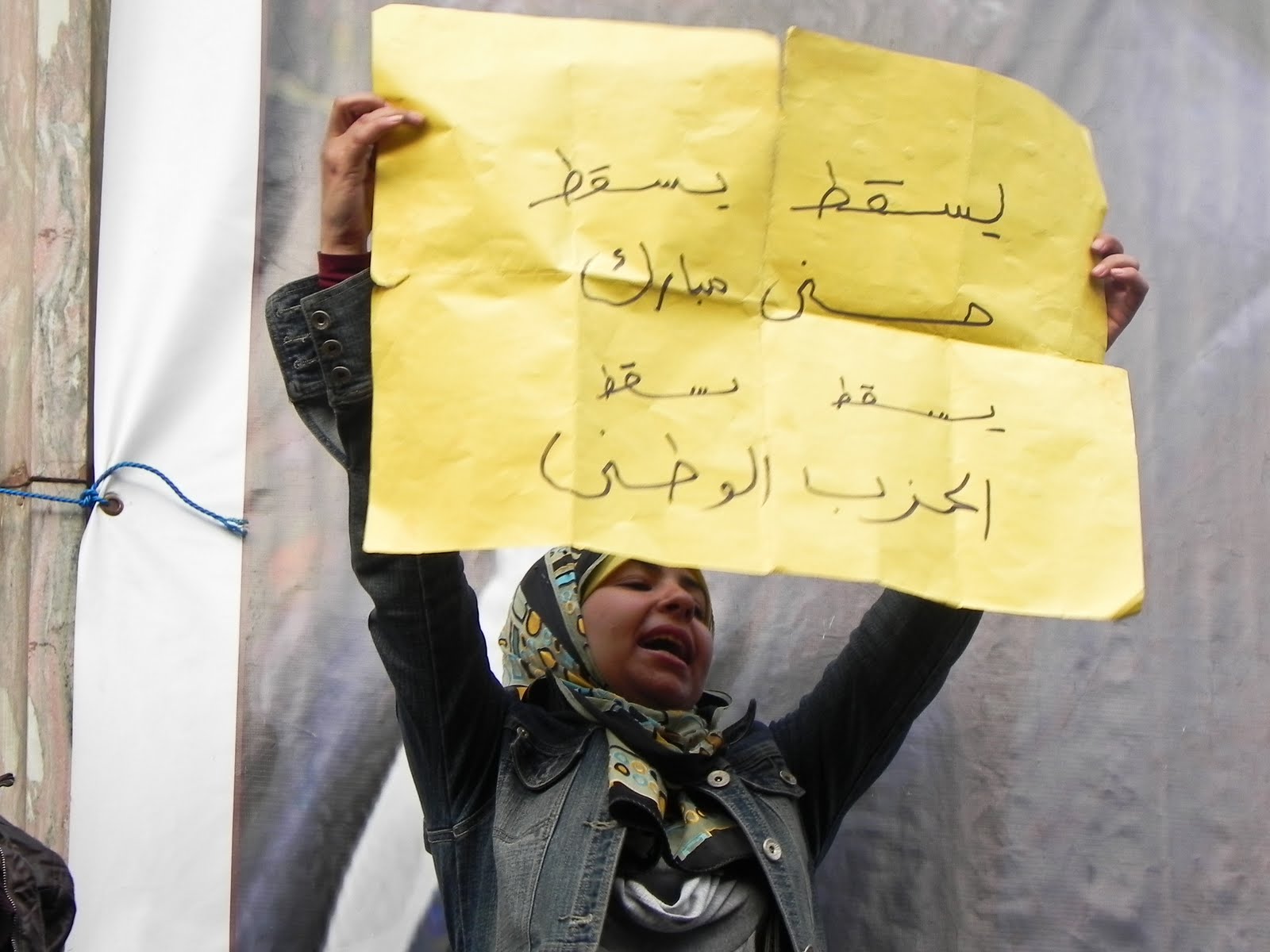 A sense of hope prevails in the streets of Cairo. Hope mixed with fear of how hard the government could crack down and uncertainty over what will happen next, but above all Egyptians have hope that maybe, just maybe, change is coming to Egypt.
For two days Egyptians have taken to the streets by the thousands, astounding both themselves and the world. Many thought the tens of thousands gathered in Tahrir Square on Tuesday night impossible in Egypt. Many thought Egyptians were too apathetic or too terrified of State Security.
On Tuesday, January 25, smaller gatherings converged on Tahrir Square through the afternoon and into the evening. Successive groups numbering from tens to thousands crossed the Qasr el-Nil brigde into one of Cairo’s most vital arteries. “Down, down with Hosni Mubarak!” they chanted.
They wore broad, sometimes giddy smiles.
Groups talked and laughed. Chants against a repressive regime sprouted again and again. Older men, some of whom participated in Egypt’s last great protests in 1977, discussed politics and smoked an endless chain of cigarettes.
Not all was peaceful: security forces hosed protesters with water and shot tear gas into the crowds. After midnight, Tahrir was ruthlessly cleared of any remnant of the day’s events.
Watching demonstrators press on through clouds of tear gas, watching families with young children brave the streets, hearing the raw emotion as Egyptians chant for freedom – one has the feeling of standing on the edge of something truly momentous.
But nothing is certain.
Wednesday, January 26 saw many small, disorganized demonstrations. The lack of communication meant no one knew where to go and most groups were quickly dispersed. It was also clear that no one expected the January 25 protests to be a success, because no one was ready for continued demonstrations on the 26th.
Even so, Egyptians have come to the streets in a way they have never done under Hosni Mubarak. The fear has been broken, and Egyptians are unlikely to give up and go home.
To quote one twenty-something Egyptian, “Tuesday was the happiest day of my life.”
Peaceful demonstrators attacked with tear gas, tasers
I caught this video last night outside Midan Talat Harb at around 9:30pm. Notice the lack of communication/coordination among the police: as two police try to talk down demonstrators, the first round of tear gas is fired from behind.
Wednesday, January 26, 2011

Tuesday, January 25, 2011
Is it a revolution?
At 8:30pm, thousands are gathered in Tahrir Square in downtown cairo. The exits are secured by volunteers, but people are allowed to exit and re-enter at multiple points. It has been a long day, and it is far from over.
A veiled girl wanders through the crowd collecting money in a helmet to bring food for everyone gathered. Every so often cheers erupt, but things are calm.
A few hours earlier, that wasn't the case. At around 3.30pm, I was with a group of roughly 2,000 Egyptians - young men and women, parents with their children, and elderly people - who made their way from Gameat al-Dowal street through Mohandiseen, across Zamalek, and into Tahrir Square. It wasn't long before State Security drove a truck through the crowd and blasted demonstrators with water. Within moments, however, a brave young man managed to climb on top of the truck and turn the water away. He was removed by plain-clothes security, but he succeeded in turning off the water.
Later, volleys of tear gas were fired into the crowd. They sent streams of white smoke through the air and billowed where they fell. Demonstrators ran from the attack - but they never went far. Despite the tear gas, the water, and falling darkness, Egyptians remained where they stood.
Throughout the march to Tahrir, demonstrators called to citizens watching from balconies: "Come, join us! Come out! Where are Egypt's people?"
Prominent opposition figure Gameela Ismail pleaded with bystanders through the entire march to join. One young woman hid behind a friend, another on a balcony smiled nervously and looked away, but an older veiled woman shrugged and stepped off the sidewalk and into the street.
A man wearing an Egyptian flag tied around his shoulders walked hand in hand with two young sons, with his wife and daughter before him.
While security has used tactics such as tear gas and hoses and many have gathered with sticks, the violence is not as bad as expected, and far from what it could be.
Rumors circulate the crowd in Tahrir that demonstrators in Alexandria and Mahalla have taken over the offices of the ruling National Democratic Party there. It is an extremely symbolic move - and the night is far from over.
Jan25: Egypt's Day of Anger
By 1pm, demonstrations in Maadi and before the Supreme Court have been confirmed, as well as demonstrations in Dar al-Salam south of Cairo and in Rafah on the Egyptian side of the border. Unconfirmed reports suggest 20,000 are moving in Old Cairo, but... I'm skeptical of that one.
Update at 1:15pm: Protest outside Supreme Court reportedly picking up. Some confrontations between protesters and security, protesters have reportedly broken through the barrier and are heading toward 26 July.
There are also reports that plainclothes security forces are carrying tasers. Police are expected to be brutal today. We will see what happens. Few reports of detentions so far, and none of violence.
Will try to keep you all updated as the day continues, but I'l heading out soon to see what's happening for myself.
@Sandmonkey reported on Twitter about 20 minutes ago that security had collected the IDs and mobile phones of everyone in Cilantro (the one on Gameat al-Dowal in Mohandiseen, I presume). Another Tweeter from that location had earlier reported the manager making calls on multiple mobile phones and security escorting 20 veiled girls off the premises.
Reports say Ayman Nour is leading a group from Bab el-Sharia to the Supreme Court, and another says police will allow a demonstration in Gameat al-Dowal at 2pm.
According to journalist Ian Lee via Twitter at 1pm, "Supreme court protest picking up. Random groups sprouting up. Police rush to contain."
@AkherElAkhbar reports police are checking cars entering Cairo. Ahram Online has reported that the demonstration in Dar al-Salam has been stopped by police, and that no demonstration is happening in Alexandria.
Will try to keep you all updated as the day continues, but I'l heading out soon to see what's happening for myself.
Update at 1:15pm: Protest outside Supreme Court reportedly picking up. Some confrontations between protesters and security, protesters have reportedly broken through the barrier and are heading toward 26 July.
Wednesday, January 12, 2011
Spiced tea, social norms, and me
As a foreigner and as a young woman I am doubly suscept to being dubbed inept when it comes to physical actions (how these classifications equate to social superiority is another subject entirely). Whether it comes to cleaning my apartment, carrying my groceries, or making a glass of spiced tea, Egyptians regard me with the same look of incredulity mixed with amusement when they realize I intend to carry out said tasks myself.
Take the glass of spiced tea I am currently sipping.
Since April I have worked part-time at a small cafe in the upscale Cairene neighborhood of Zamalek (actually located on an island in the middle of the Nile). My current tasks are usually coming up with unique and tasty soups during the week and making waffles on Saturday mornings, but for a while I opened up shop at 7am three to four days a week.
I knew how to make an espresso, a cappuccino, and everything in between from my days as a barista in Rome, and making sandwiches and salads is kind of a no-brainer. I just had to remember how much everything cost and I was pretty much set.
The shop has seen a couple makeovers in the nine months I've worked here, and at this point I'm actually the second-oldest employee. However, I'm also the only foreigner (read: light-skinned American) and I still work part-time. This means that the other employees constantly want to do things for me and I still get thanked for washing the dishes - even if it's entirely my own soup-making mess.
I also enjoy the cafe as a place to chill and write. A few minutes ago I took a break from writing (my other job) and headed down to the kitchen to make myself a glass of spiced tea. Aya, one of the girls who works in the cafe, watched me for a few moments before saying, "I make it."
The scene isn't particularly uncommon and I resigned myself to the bar stool with an amused smile. When Aya finished her current task, she looked at my glass, shook her head, and dumped it out. "No way!" she told me. A few minutes later she handed me my glass of spiced tea with the perfect amount of foam and a dash of cinnamon on top. I thanked her profusely and retreated back to my laptop with my steaming cup.
I adore Aya. She's a cute young Egyptian girl with a bit of spunk and a good sense of humor. She's a diligent worker even if she does work at the slow, steady speed typical of Egyptians. She speaks enough English that we understand each other decently and my attempts at Arabic incessantly send her into fits of giggles (she still can't believe I know what leben rayeb is; it's buttermilk). But she still asks me if I need help every time I go to buy vegetables, even though the vegetable man knows me, and thanks me when I wash the dishes. She's a dear, but I doubt she'll ever take me seriously as an employee at the cafe: I'll always be the nice foreign girl who comes in sometimes and is friends with the owner (who I met only because she was looking for part-time employees and I needed a hobby).
Similarly, my landlord was bemused when I told him I clean the apartment myself (I've since resorted to assuring him my old cleaning lady comes), and I'll never forget the look of shock on one upper-class Egyptian friend's face when he saw me scrubbing my kitchen the first day I moved into my flat. He simply couldn't understand why I would resort to doing such things myself, never mind that there were old grease stains everywhere.
(I do recognize that there are deeper underlying social norms and concepts tracing back hundreds of years contributing to many of these experiences, but again, that particular academic debate is another issue entirely.)
Occasionally having to insist that I am quite competent gets a bit old. Yes, I can clean. Yes, I can unclog the drain. Yes, I can carry my groceries. Yes, I can iron my shirt. Yes, I can flag down a cab and tell him where I need to go. Really. I promise. I'll be fine.
But frustrating or not, being underestimated has its benefits. Police seldom take me seriously at demonstrations, and consequently aren't bothered by me. I never stop or take my keys out of my pockets when I go through metal detectors, I've talked my way into sporting clubs without an ID, and I've gotten into various government buildings simply because no one can imagine that I - a young, confidant white foreign girl - would be near any of these places if I didn't belong there.
Even so, yes, Aya, I can make my own spiced tea.
Sunday, December 5, 2010
Elections round 2 so far...
 By 2pm, there are a few things we know about the second round of parliamentary elections in Egypt today:
- 283 seats, more than half the total number of seats in parliament, are being contested today (meaning no candidate for those seats won the 50%+1 majority needed in last Sunday's elections).
- Of those seats, 188 are being contested between members of the same party - the ruling National Democratic Party (NDP). 114 are being contested outright between NDP members, and another 74 are being contested between NDP members and independents running under the party's platform.
- There are rumors that in an attempt to fix its massive over-rigging last week, the goverment is rigging votes in favor of non-NDP candidates this time around. According to tweets and Al-Ahram's English online portal, an NDP candidate in Dakahleya's Aga district has withdrawn from today's runoff citing vote-rigging in favor of his competitor, a Tagammu candidate.
- Voter turnout is, as expected, noticeably lower than it was last week. According to the High Elections Commission (HEC), voter turnout last Sunday was 35% (There is strong suspicion that the number is vastly inflated. In Qasr el-Nil, a strategic district in downtown Cairo, only about 8.5% of registered voters cast ballots). We'll see what the "official" numbers are, but voter turnout might hover around 10% at the most today.
- Reports of violence, vote-rigging, polling stations opening late, representatives and monitors not being allowed into polling stations, and other irregularities have already been reported.
- Only 2 of 9 Wafd party run-off candidates headed the party's decision to boycott the second round of elections. Wafd party officials say those who disobeyed the party's order will be stripped of their party membership.
- Even if every independent and opposition candidate won their seat today - including those of the Wafd and Muslim Brotherhood who are boycotting - the NDP would still control approximately 80% of the seats in Parliament.
That's it for now, folks. Tune in later for more updates.
Subscribe to:
Comments (Atom)